Honey

I always carry honey when hunting or training or judging. It is my “go to” remedy. Not only is it a life saver in hyperthermia (heat stroke), it is scientifically proven to be effective on wounds, burns, skin ulcers, boils, and infections.
Honey is one of nature’s oldest folk remedies used by many ancient civilizations to help heal wounds.
Scientific university research is showing the reason why honey could assist natural healing. Results of a University study showed that unprocessed honey healed wounds and external ulcers in all but one of 59 patients. Honey, keeps sterile wounds sterile until they had time to heal, while infected wounds became sterile within a week. It provides a moist healing environment yet prevents bacterial growth even when wounds are heavily infected.
How does honey do this? For one, honey’s acidity, or pH, is low, preventing the growth of many species of bacteria. It tends to absorb water from a wound, which deprives bacteria of the moisture they need to thrive. When honey is diluted (i.e., from fluids from a wound) an enzyme is activated that produces hydrogen peroxide, a potent antibacterial. Honey dressings don’t stick to wounds, making it easy to change dressings with no tearing away of newly formed tissue.
True story: I am a judge for the North American Versatile Hunting Dog Association (NAVHDA) and travel all over North America judging hunting dogs. As a Senior judge (one of the three judges must be the “Senior”) I find myself often in charge of tests. This means I am responsible for executing the test from the test logistics to the dogs to the handlers to the spectators. A couple years ago in southern California I had an experience that I will never forget.
First of all, the temperatures were 103 degrees Fahrenheit by 11AM all 3 days of the test. In the tests, we do field work, water work, and tracking. The field work is 20-30 minutes long, so we tried to get all of that out of the way first thing in the morning. However, we did not get to the tracking portion until the end of the day. Tracking USUALLY takes no more than 2-4 minutes for dogs in the test we were doing…Utility. We do not call it tracking, as the dog is only expected to follow the scent of a person dragging a dead duck behind them about 100 yards and then leaving it there for a dog to find and return to the handler…so you can imagine, the scent of that is pretty strong, and the distance is not far for an upland bird dog to run out and back.
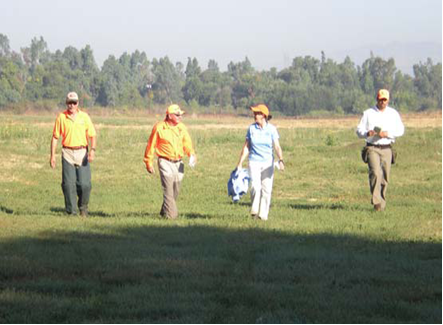 Judging Team Southern Cal NAVHDA, 2010
Greg Weiss, Herbert Schoderer, Senior Judge Cheryl Asmus
Aprentice Judge Gabriel Awbrey
Well, that day was so hot and dry and the wind…the wind was gusting about 30 mph. Each judge takes turns dragging the duck and then hiding in the woods. It was my turn. I dragged the duck out about 140 steps, left it there, and went to hide in the shaded woods (after looking for rattle snakes that might have the same idea!). The other two judges then brought out the handler and his dog who had been out of sight to the spot where the “track” started. He unleashed her, a young solid liver German Shorthaired Pointer, and she tore off down the track. Due to the wind, the track scent had blown a good 60 yards to the right so she got off the actual track air scenting landing her a good 60 yards downwind of the bird laying on the ground. She started searching, she ran and ran and ran. It was about 9 minutes into it at that point and I finally saw her run by me and pick up the duck….she was not well. I knew that instantly. I am not sure what I “saw” in the brief glimpse, but I instantly stood up and started sprinting toward the spectators, owner, and other judges. I was screaming “Get some water” “Get some water”…the wind blew my voice away. The dog stopped about 10 yards from the owner and just stood there. By this time, someone heard me, and a spectator bolted from the crowd and yanked the duck out of the dog (which was covering its tongue…the place a dog sweats from), swooped her up and put her in a tub of cool(er) water in the shade by his truck (we had tubs of water everywhere to keep the dogs cool).
 I ran to her and held her head up in that water as she was too weak to hold it herself. She was in shock but conscious. Her rectal temperature was over 105 when we first took it. We took her temperature every 5 minutes until it was normal. After her temperature dropped to under 103, we dryed her off and put her in an air conditioned car and off to the vet. She ended up being fine.
One other thing we did, was we gave her small amounts of honey on our finger and put it inside her cheek …about 2 Tablespoons in all over the 30 minutes in the water.
Honey-don’t leave home without it!