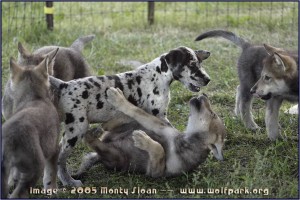
 Dominance Behavior in Dogs and Wolves

Speaker: Monty Sloan
Description: Monty Sloan, trainer and handler from the beginning at Wolf Park, discusses “Dominance Theory” and how it applies differently to dogs and wolves. Also addressed is the relevance of “dominance” in captive and wild wolf packs, and in groups of dogs, including the differences between dominance and leadership. Monty’s lectures are RICH in photography and real experiences with wolves and observing behavior in both wolves and dogs. Knowing the differences between dominance and leadership in your actions with your dogs will help you be a better trainer and have a safer and closer relationship with your dog. Dogs also have both dominant and leader positions in groups with each other. Being able to observe your dog in a group such as at a dog park or in your own home and understanding what behavior he is exhibiting will also keep your dog safe and increase the positive appropriate relationships in the dog group.
Excerpt-
Dominance behavior in dogs is often confused with aggression
Aggression is often the RESULT of a dominance interaction, especially in a captive wolf pack, but aggression is not in and of itself dominance. Aggression does not need to be dominance related and is not a necessary component of a dominance interaction.
Recorded: March, 2011
Cost: $25.00

CEU’s Available:
2 IAABC CEU’s
2 CCPDT CEU’s (2 CBCC-KA or 2 CPDT-KA)
2 ABCDT-L2 CEU’s
2 NADOI CEU’s
2 PPAB/PPG
Professional Member Discounts
 Members of APDT, CCPDT, IAABC, ABCDT-L2 or NADOI receive over 25% off. All Lecture Series Webinars are only $18.00 each. You must email me for the Code for your discount: cheryl@e-trainingfordogs.com (Please also include your CPDT or CBCC Certificant number in the email if you are a CCPDT Certificant).
IAABC members, Click HERE to apply your discount.
Email cheryl@e-trainingfordogs for the passcode.

 Dog Play Turns Aggressive?
 Dog Emotions Speaker: Kellie Snider, MS Description: This lecture will help improve the ability of participants to accurately observe dogs in real world situations, to understand how dog emotions play a role in learning, and how emotions themselves can be learned behaviors. Join Kellie as she discusses how dog emotions can be learned behavior and how our awareness of the antecedents and consequences that attach to emotional behavior makes us better at training and modifying behavior This webinar will cover: