 Lessons in Fear and Aggression – Part 4 – Training and Understanding the Reactive and Aggressive Dog
Purpose: The purpose of this course is to offer training options for the reactive and aggressive dog in addition to BAT and LAT. Several case studies are presented to offer a variety of approaches for resolving reactivity and aggression problems.
Prerequisites
Understanding of the LIMA (least intrusive, minimally adverse) principle for dog training.
Understanding and experience with counter-conditioning and desensitization techniques (you will learn these in Lessons in Fear and Aggression Parts I, II, and III).
Courses required : Lessons in Fear and Aggression parts I, II, III.
Required reading:
- Articles: ”Calming Signals that Work.” www.peggyswager.com and “Communicate with Calming Signals” peggyswager.blogspot.com
- Required books to read:
Rescue Your Dog from Fear by Peggy Swager
On Talking Terms with Dogs, Calming Signals by Turid Rugaas
What you can expect to learn from this course:
The course begins by looking at how professionals structure training to control reactivity in breeds whose working purpose is to react to certain stimulus.
There is a review of different training tools which are used to work with reactivity and training. Recommendation on tools to use and not to use is included.
 Since treats are often a tool used with this kind of training for the reactive and aggressive dog, a look at treat-training failure can help trainers learn to solve treat related problems. This can allow for better relationships which work towards reform.
Case studies help present techniques for solving reactivity and aggression issues and include examples of modification of some of the techniques to fit the needs for training a specific dog issue.
Case Studies include:
- Reform of an instantaneously reactive Rottweiler
- Reform of an extremely leash reactive Australian Shepherd
- Reform of a dog with a pushy personality who became extremely aggressive towards another dog in the household
- Critique of ongoing work to reform the reactivity in an older ex-police dog
- Reform of a Jack Russell terrier who attacked horses
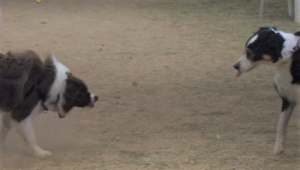
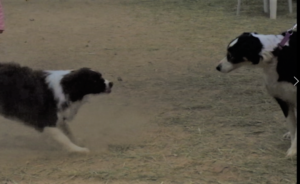
A video review followed by stills helps show body language seen in a reactive and aggressive dog.
CEUs and/or a Certificate of Completion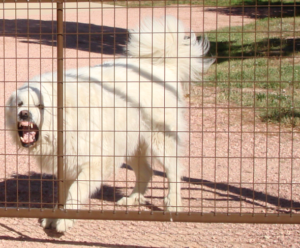
There are ten sections which range between 80 and 180 minutes. Ten quizzes and a final exam must be passed to earn CEUs or a Certificate of Completion.
Quizzes and tests: There are 70 quiz questions and 30 final test questions for a total of 100 points. A total score of at least 80% must be earned to earn CEUs or a Certificate of Completion.
CEUs:
CCPDT – 10 CPDT-KA, 5 CBCC-KA (15 CPDT-KA)
IAABC – pending
Other organizations on request (cheryl@e-trainingfordogs.com)
Cost: $285.00 USD (For Credit-Includes Instructor contact, Certificate of Completion and CEUs)

AUDIT Cost: $140.00 USD (NO Certificate of Completion and NO CEUs)

Instructor Biography:
 Peggy O. Swager, B.S., Prior to her work with dogs, behaviorist Peggy Swager worked for years solving behavior issues in horses where she honed her desensitization skills. Her first published article in a national magazine was on neurosis in training. In the 1990’s Peggy transitioned her behavioral work to dogs. In 2010, she agreed to train two mill dog rescues from the National Mill Dog Rescue, who were not adoptable and were too difficult for regular mill dog fosters. She was able to solve behavior issues in both dogs, finding them forever homes. Peggy has consulted on many dog cases, resolving issues where other trainers have failed. She has authored several accredited online courses, and has authored multiple articles and books. She received five DWAA awards. She has a BS in biology, minor in education, with undergraduate studies in psychology. She received mentoring by animal professionals, including a DVM, on behavior and fear issues.