By Barbara Handelman M.Ed., CDBC
“Dogs don’t learn by observation” was a myth promulgated as truth when positive punishment (P+) training methods solidly dominated professional dog training circles. Back then, most trainers believed that dogs learned what trainers set out to teach them. Few discussed other ways dog might learn, certainly not by observation, or error-free reward-based training.
My Australian Shepherd, Moon, began retiring from his service dog career after only four-short years, due to stress while on the job. Moon remained my agility partner for years to come. He also patiently transitioned to a new job as a puppy raiser. Luca, an 8-week-old German Shepherd puppy became Moon’s successor as my service dog, and greatly benefited from Moon’s mentoring.
Moon watched Luca’s task training sessions intently. During a session when I began training Luca to target and then push up a light switch with his nose, Moon watched each repetition Luca made and for which he received a click and a treat. Moon was highly food motivated, and eagerly participated in any activity that garnered treats.
Moon’s turn with the light switch followed immediately after Luca’s. When I presented the light switch to Moon for his first attempt, he began just where Luca had left off. Moon required none of the successive approximations Luca had practiced to get to his ending point. It was clear that Moon had not only observed Luca, but he learned a new skill through observation. Such observational learning remained Moon’s specialty throughout his life.
There are many advantages to raising a puppy in a household with a socially adept older dog. Dog-to-dog rules of engagement learned first from their mother and then among littermates often continue on within a multi-dog household. Older dogs also “self-handicap” in order to not injure puppies during rough and tumble play. They titrate the pressure of their mature jaws in order not to hurt a pup while jaw wrestling, and they’ll pull with less vigor in order to keep a game of tug going and not frighten or overwhelm by pulling the little one off his feet. As puppies mature, older dogs will gently correct with modulated force or vocalization the pup who bites hard enough to hurt. The presence of an older dog, who models appropriate canine body language helps the puppy develop his own interactive expressive vocabulary. Becoming well-versed in the art of “speaking dog” serves the pup for a lifetime among dogs in his ever-expanding community.
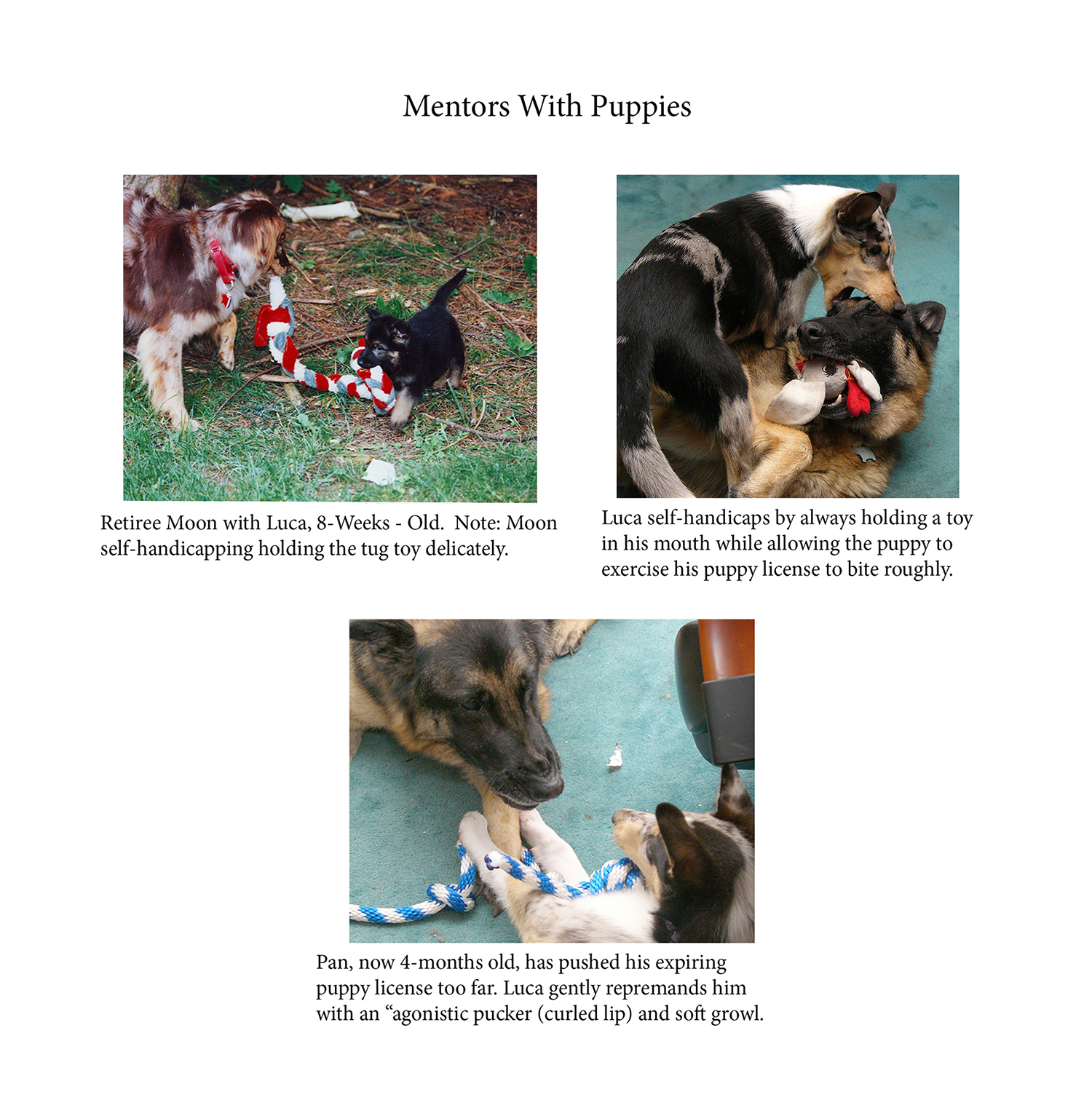
Retiring service dogs can effectively teach service dog behavior and etiquette by modeling appropriate behavior during public access outings. Most puppies raised without a canine mentor, must wait until they are 5-to 6-months-old to develop the self-control with which to venture into restaurants or doctors’ offices. Working a seasoned service dog in tandem with a young puppy can begin when an appropriate pup is only 3-4 months-old.
 Taking such young puppies out into the community requires extra vigilance on the part of the handler. When he was only 12-weeks old, I took Gusto to a familiar local restaurant, long accustomed to welcoming the presence of my older working dogs. During these outings, I always parked near an entrance, and sat at a table near the same door, so that if Gusto was restless or otherwise required a hasty, unobtrusive, retreat it was easy to accomplish.
Handlers venturing out with young puppies must ensure that a puppy has had ample time and opportunity to adequately eliminate before entering a place of public accommodation. If a pup becomes restless, be prepared to take them outside quickly, or have supplies along for a quick and complete cleanup. If the pup shows any signs of stress, leave immediately and return to pay without the pup if necessary.
If the pup seems alarmed by noise, crowds, running or crying children, strangers approaching, service carts rattling past, quickly leave with the pup. Be aware of fear periods that come and go. It is unwise to pressure a puppy to habituate to frightening sites or sounds, especially not during a fear period. Classical conditioning, practicing something familiar and calming, in the form of offering special treats, may be useful if the pup is simply startled. Give the pup a chance to recover quickly. However, if the pup won’t accept a favorite treat, that is a certain indication that they are too stressed to stay in the situation. Best to calmly but quickly remove them from the environment.
I have never found a more effective way to build confidence in a puppy than the presence of an older dog who models calm in unfamiliar, crowded, or noisy environments. Most puppies simply absorb the adult dog’s relaxed attitude and mirror the calming body language their mentor models.
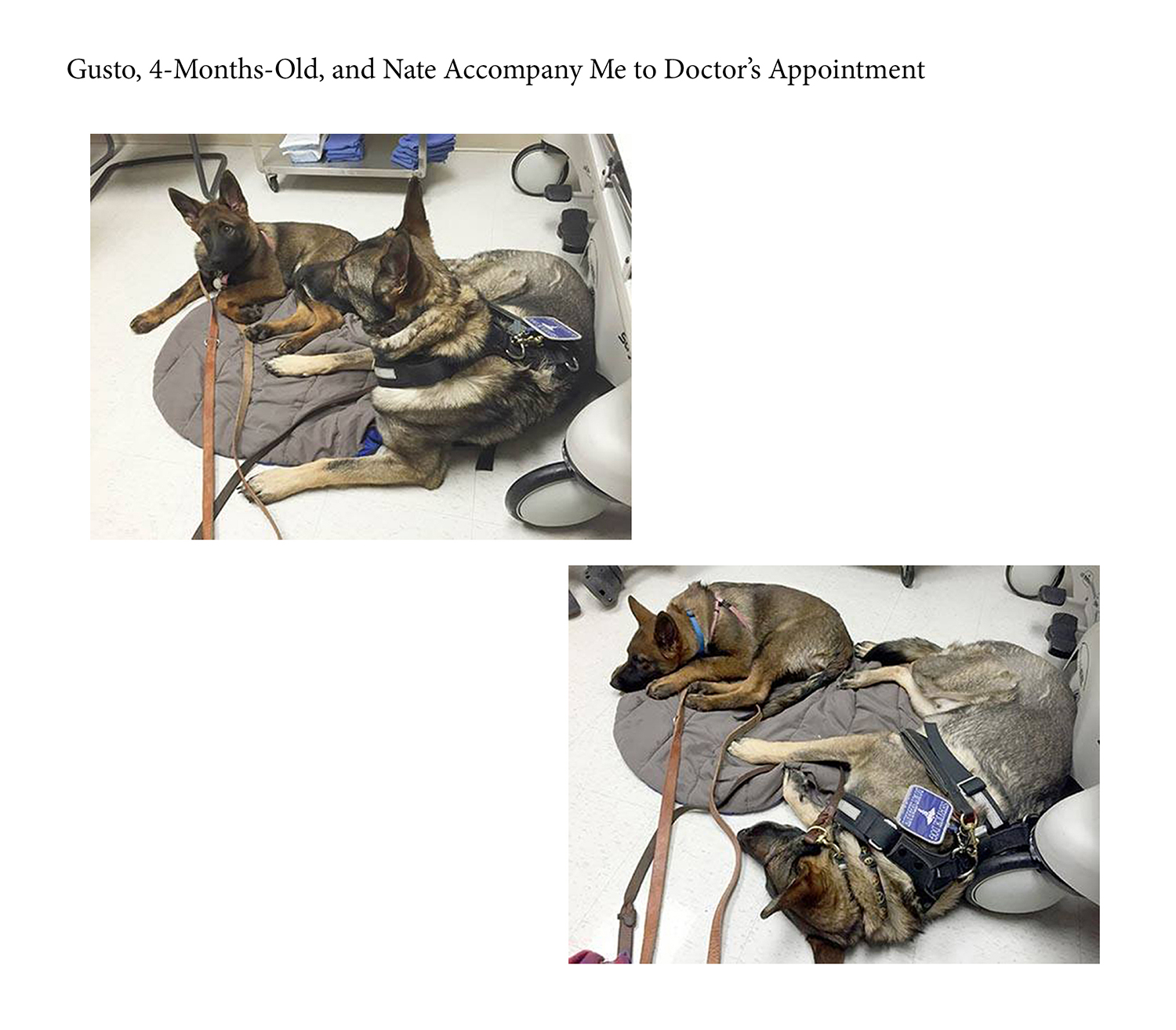
Adolescent Service Dogs in Training (SDIT) can also benefit greatly from a mentor. In particular, they can learn to stretch their developing tolerance for a long down stay. Often the restless teenager will relax during a long medical appointment, because that is what their role-model is doing. An obstreperous or impatient youngster who tries to temptingly invite his mentor to play, will benefit from the mentor’s rejection of the play overtures and his modeling of appropriately quiet, relaxed behavior.
As described, pups and adolescent service dog can benefit greatly from having a canine mentor. Mentors also benefit from their participation in the successor’s training. Most retirees feel stressed if they are suddenly left at home while the youngster goes out for most if not all the public access outings. Sudden changes in the older dog’s routine may transform the youngster from friend to intruder in the seasoned dog’s mind. The retiree may actually develop new or exacerbated separation anxiety, or depression upon being left alone for long hours after a lifetime of going everywhere with their handler.
Being a mentor necessarily spans many months, sometimes a year or more. Frequency of work-in-tandem gradually decreases. Over time the retiree goes on fewer outings, while he also has time to adapt to being left home alone more often.
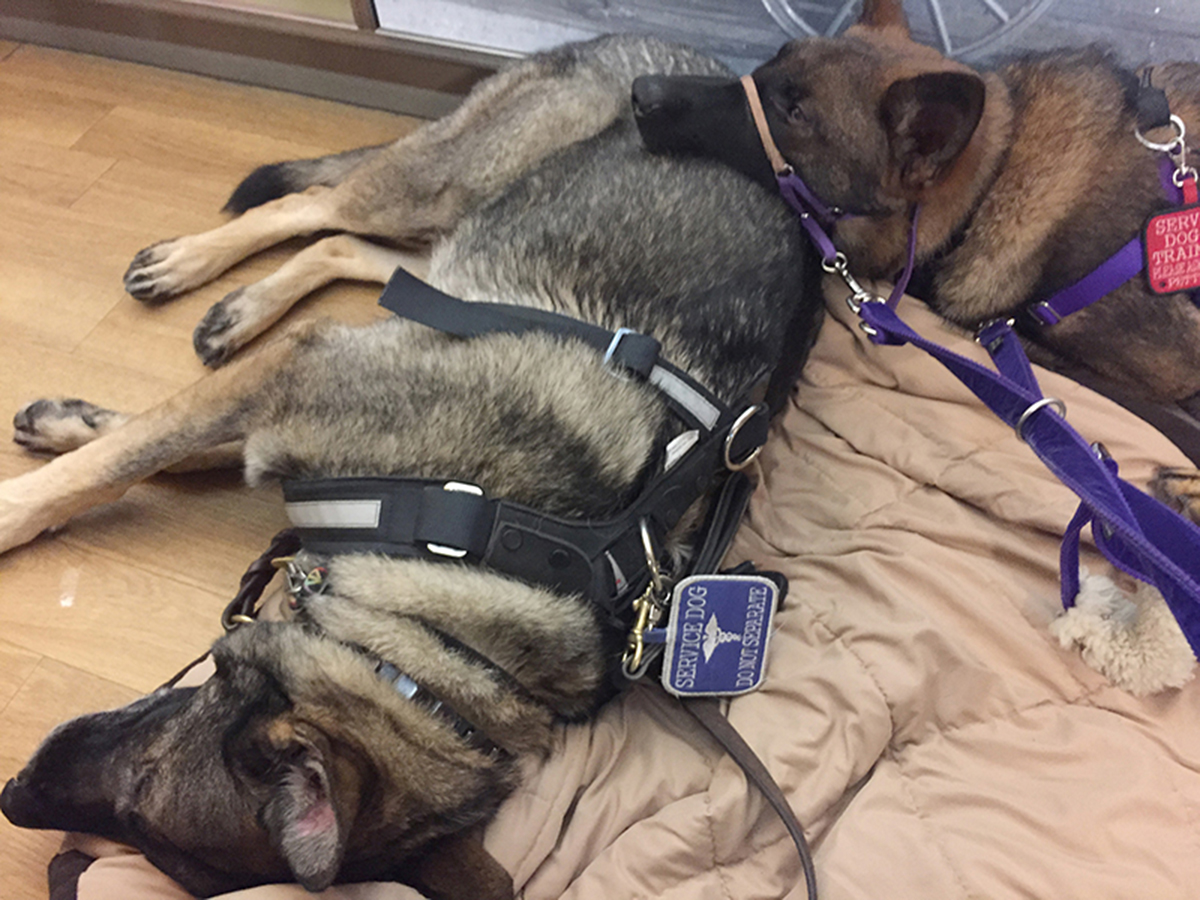
Nate, my German Shepherd (GSD) service dog, came to me at the age of nineteen-months. Nate had just been released from training by the Fidelco Guide Dog Foundation, at the same moment in time when my service dog Pan, a smooth coated collie, died suddenly at the age of four-years. Pan’s death happened without warning. He had a catastrophic spinal stroke, and collapsed in the woods. He was paralyzed from his mid-back down. I opted for humane euthanization, to free him from a long, painful, and uncertain course of surgery and rehabilitation. Nate’s failure as a guide dog candidate, and his need for an immediate career change proved a synchronistic boon.
Nate and I had a fabulous eight-year partnership. The average working-life of a GSD service dog is about nine-years. His transition from full-time service dog work to retirement began gradually. I actually started looking for his successor, years before. I located his litter when Nate was just turning seven-years-old. I assumed basic training of his successor would take two full years. Time enough to raise Gusto from puppy to proficient adult working dog.
Nate’s temperament was so ideal, I joked that I would happily clone him in order to find his successor. I came as close as I possibly could in Gusto. Nate’s mother, and Gusto’s mother were full sisters from different litters.
Gusto was with us until he was eight-months-old. Sadly, when he hit adolescence he transformed from a low-drive, thoughtful pup into an extremely high-drive and powerful dog. He became too much for me, at my current level of disability, to handle. His departure was heart-wrenching for me and for Nate. It was more than a month after Gusto left before Piper, then approximately eight-months-old, entered our home. Piper, we speculate, is a border collie, Australian cattle dog, husky mix. He is athletic and brilliant, a medium-size dog half Nate’s height and weight.
Gusto followed Nate’s lead in everything they did together. When Piper arrived, he was a full-blown adolescent who had just been neutered. He’d spent part of his life as a stray, likely having had to scavenge for food in order to survive. Consequently, Piper entered our home with resource guarding issues. His first day in the house he challenged Nate for their mutually favorite resource, me! Fortunately, Nate is the ultimate gentleman, he has no interest in fighting. He will stand his ground if he must, but will only use superbly inhibited bites accompanied by a lot of noise and bluster. Piper, on the other hand, had developed only poor bite inhibition in his early life, and would unreservedly continue to challenge Nate, until I hastily intervened with the blast of an air horn. Were it not for Nate’s innate pacifistic personality, and his forgiveness toward his protégé, their co-existence might have quickly become untenable.
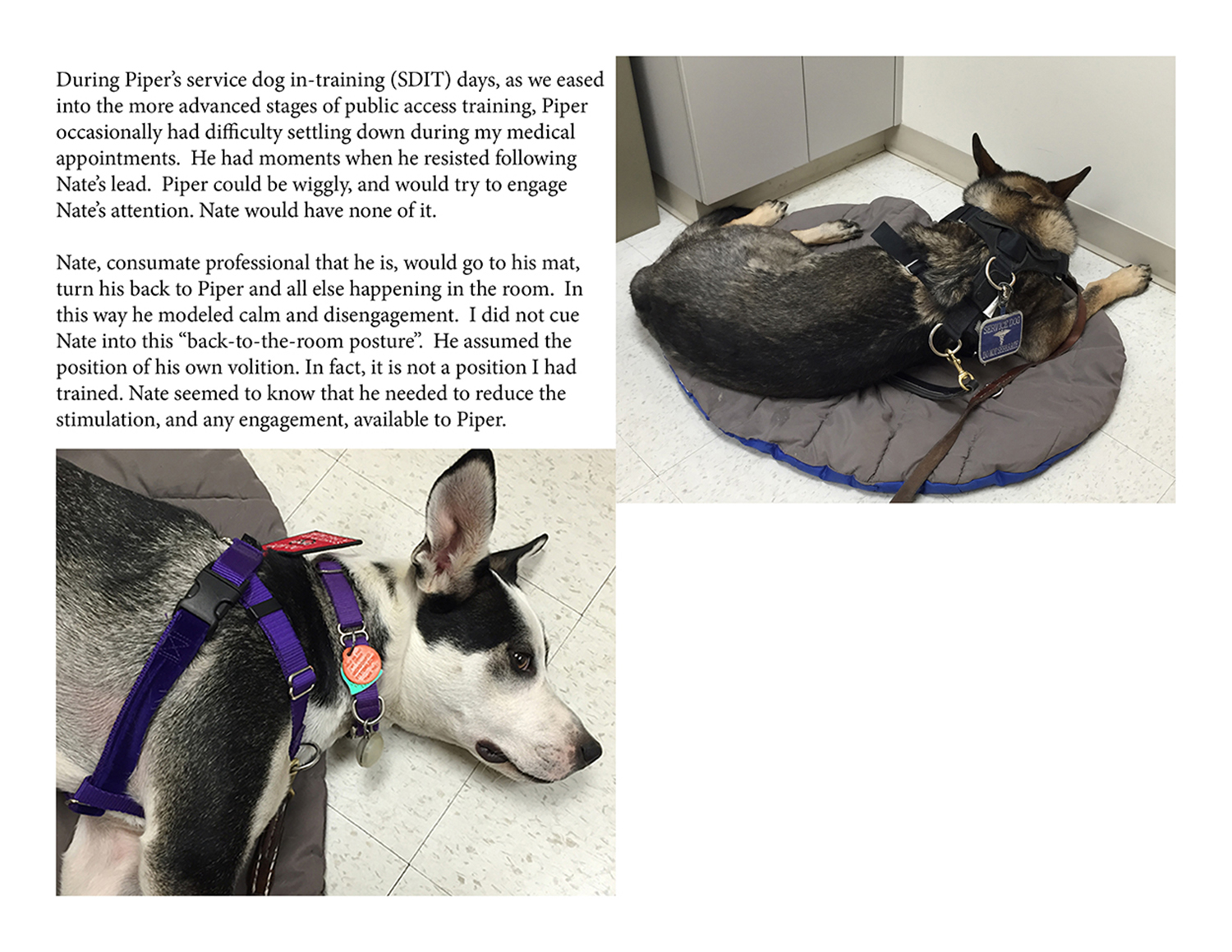
Retiring a loyal working dog is inevitably emotionally difficult for the handler and the dog. Sometimes there is time to plan for it, and facilitate gradual adjustment for the retiree. Sometimes due to illness, structural problems, or injury, retirement may be sudden. The best of all possibilities happens when the older dog naturally assumes the role of mentor. Mentoring profoundly benefits both dogs, it provides modeling of appropriate behavior for the successor dog, that no human trainer can replicate. The handler, working the retiree and protégé in tandem, embarks on a highly beneficial adventure.
References
Can Dogs Learn by Observation?
https://www.clickertraining.com/node/231
Help ‘Em Up Blog
What Your Older Dog Can Teach a Puppy
February 15, 2018 Dog Health
https://helpemup.com/what-your-older-dog-can-teach-a-puppy/
Dogs Learn by Modeling the Behavior of Other Dogs