Canine Problem Behaviors – Peggy Swager Courses
Courses
Peggy teaches the following courses on canine problem behaviors including separation anxiety, fear, house training, reactivity and aggression.
Purchase below or click on each course for more information:
Solving Separation Anxiety in Dogs – Video on Demand (VOD)
VOD only – $25

Solving Separation Anxiety in Dogs
Course + VOD – $115
Solving House Training Issues
Course -$100 USD
Lessons in Fear and Aggression in Dogs Part 1 – Science and the Art of Desensitization
Course – $185 USD
Lessons in Fear Aggression In Dogs Part 2 – Identifying and Solving Conditioned Fear Responses
Course – $185 USD
Lessons in Fear and Aggression Part 3 – Advanced Desensitization Techniques
Course – $210 USD
Lessons in Fear and Aggression – Parts 1, 2, and 3
10% off the purchase of all three – $522 USD
Lessons in Fear and Aggression Part 4 – Training and Understanding the Reactive and Aggressive Dog
Course – $285 USD
Peggy’s Blog Posts on Aggression
Dog to Dog Aggression-Part 1
Dog to Dog Aggression-Part 2
Dog to Dog Aggression-Part 3
Dog-to-Dog Aggression Part 4: Chamois
An Unexpected Study in Dog Reactivity-Part 1
An Unexpected Study in Dog Reactivity-Part 2
 Peggy Swager
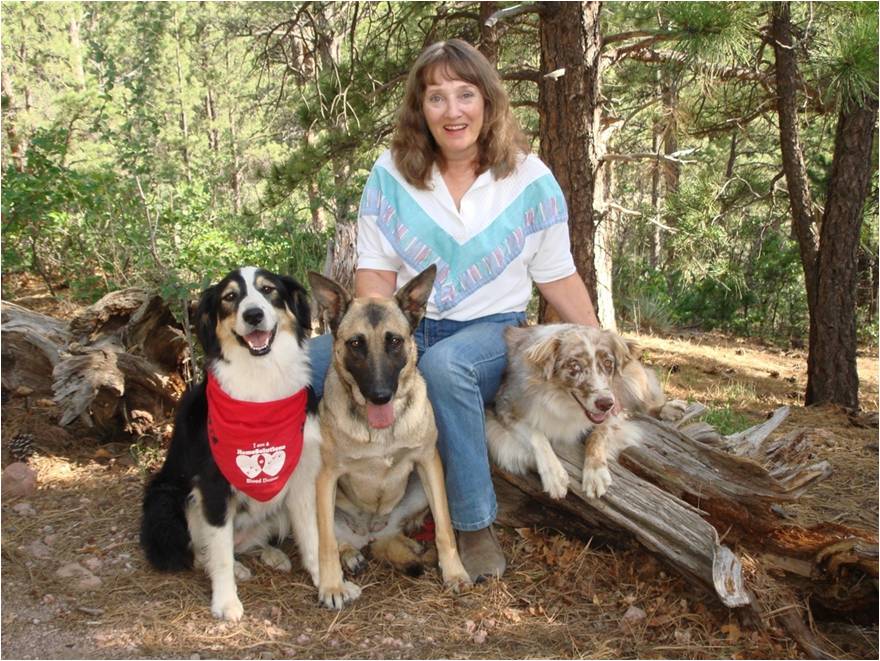
Some common canine behavior problems include canine anxiety, housetraining issues, fear and aggression among others. Peggy Swager, one of our Instructors is a long time behavior consultant who has successfully worked with these problems, and more in her long career.
Peggy holds a BS in biology, minor in education, with undergraduate studies in psychology. Over the years, she received mentoring by animal professionals, including a DVM, on behavior and fear issues. Mentored under trainers and attended training lectures at Pikes Peak Obedience Club. Taught the puppy classes. Dr. Dunbar lecture in Denver, CO, 2016 ADPT conference attendee.
Presenter at APDT Conference. Author of many dog books and training articles, and a DVD on Separation Anxiety. Magazines that published my articles included AKC Gazette, AKC Family Dog, Dog World, and APDT’s Chronicle of the Dog. Award nominations and awards for books, articles, and the DVD. My extensive research for article writing, included interviews of professional trainers, which help hone training skills. Specialized in more difficult cases.
Peggy Swager graduated in 1978 with a BS in Biology with a minor in education. The degree includes several classes in psychology. She also took a class called Animal Ecology which included field studies as well as information on the handling of animals at the Denver Zoo.
In her early years, Peggy honed her skills by working with horses who had moderate to severe behavioral issues. This included horses who had herd bound issues-the equine equivalent of separation anxiety in dogs. She had three articles published in popular horse magazines which addressed how changes in training techniques could be valuable to horse behavior. Peggy reduced her work with animals for several years while raising a family. About twenty years ago, she once again ventured into the business by working with problematic dogs. Peggy taught dog classes including puppy class, agility, and obedience. She has shown in obedience and agility. She has worked with a variety of dogs to resolve behavior issues. Over the years, Peggy has developed several techniques to help resolve separation anxiety in dogs, including mill dog rescues and other shelter dogs.
An Unexpected Study in Dog Reactivity-Part 1
By Peggy Swager
For me to get to my riding and hiking trails ¾ of a mile from where I live, it is necessary for me to go on dirt roads to the beginning of those hiking paths. I’ve lived in the same area for over thirty years. At first making this ¾ of a mile trek was not a problem. However, over time, people moved into the area, fencing in their five acres with the concept that a dog finds ecstasy when allowed to roam all day on five acres. Most of the dogs allowed to roam, provided me with an unexpected opportunity to study how barrier aggression and territorial aggression can develop in different dogs.
The most problematic dogs in the subdivision where I live were on my path to get to the hiking trails. Making these dogs all the more problematic was that when walking on the road, you could sometimes encounter three different sources of reactive dogs all at once. We quickly named this location Dog Hill. Below I have tried to give a visual illustration of Dog Hill so I can better discuss the development and progression of the different dog’s behaviors.

My house was about 3/8 of a mile from the beginning of the lots for the German Shepherds and the Great Pyrenees. The German Shepherds were only in that location for two years. The dogs were kept in a kennel off of the road and were almost never out without their trainer, although one time one did escape. These dogs would bark when you went by. The barking by itself was not an issue since the dog’s distance from the road was far enough as to not upset either horse or dog. However, once a dog became apprehensive about the other dogs on Dog Hill, the barking German Shepherds would often tense the dog I was walking, adding to the dog’s concern about encountering the problematic dogs.
Duchess and Bear
I have a bad attitude about people with corner lots. If you think about it, corner lots can have a lot of road exposure. I find people with corner lots more often than not end up with problematic animals. This was true of Duchess and Bear, though Duchess was not as problematic as Bear. The fencing of Duchess’ and Bear’s property allowed the dogs access to the road in two areas. When you added up the road frontage, you found the dogs could harass people for almost a quarter of a mile.
Unfortunately, I didn’t get pictures of Bear and Duchess at the beginning of where I might encounter them on their property. That was in part because they often didn’t see me coming until part way up Dog Hill. The times these two dogs saw me at the beginning of their property, the dogs would run to the fence and bark to fend me off. Great Pyrenees are a livestock guarding breed. This kind of breeding offers these dogs genetics that can make the dog more territorial. Add to that the fence as a barrier … and you can end up with barrier aggression.
Near the top of Dog Hill (before I turned the corner to go back down towards the end of Duchess and Bear’s zone), was the gate to the property. Since the dogs were often closer to the house, this was one place I most often began my encounter with these dogs.

Both dogs often laid outside the house and when they saw me come by, they’d race to the gate. Both would bark, but it was Bear who showed more aggression.
Duchess is on the left and Bear is on the right. Bear was always more aggressive than Duchess. Sadly, Duchess died at a younger age. Bear kept up his reign of terror for twelve years, the dog was a year old when he moved to the property, so he made it to thirteen years old when he died. Even when he was fairly feeble, he was still aggressive and would chase cars that came by. Any time Bear saw people go by, dogs and people go by, and horses go by, he was relentless when it came to barking and showing aggression. My understanding was that these two dogs were not related. I found it good information to see how the same breed of dog, with different breeding genetics, reacted differently to the same situation.
These dogs persisted to follow the fence line once I was discovered. The dogs used barking and Bear would also lunge at the fence to try and drive me away from their property. Duchess seemed to feel after she’d alerted to my presence, that her job was done. Making Bear all the more terrifying to either dogs I was walking or a horse I was riding, was that he could pop in and out of bush and scrub oak when he was launching his attempts to keep me away from his property.

There were several areas where Bear could pop out of bush and scrub oak. This would increase the angst in any dog I was walking or could spook a horse I was riding.
The only thing that stopped Bear’s harassment was the end of the fenced property. There was another property I had to go by before turning again and walking the final 1/8 of a mile to the trail. Sometimes these dogs were out on that five-acre property, and they did have access to running up to the road. This set of dogs were occasionally out, and would rush up to the fence. However, these two dogs were not that threatening. Unfortunately, these two dogs didn’t need to be very threatening to worry a dog on the leash who was already upset about Bear’s activities. Adding yet another set of barking dogs running up to the fence worked to create more frequency of this kind of fear evoking encounter, as well as extended the duration.

This is a picture of Bear and Duchess at the far end of their property. Note that Bear looks aggressive and Duchess does not.
Duchess had gotten out once and I encountered her on the road. She was amiable towards me. Bear also got out once, but was intent on attacking me. At the time I had begun carrying pepper spray because I had a dog attacked and almost killed on the hiking trail by a loose dog.
The time Bear wanted to attack me, he’d slipped out of his gate. Bear was marching right up to me with a stare that is hard to describe. Ironically, a week before I had interviewed a twelve-year-old kid that was attacked by a dog at his friend’s home. The kid had said the attacking dog was staring at him in a strange way, then the next thing the kid knew he’d awoken in a hospital, a result of a dog attack.
When I saw the look in Bear’s eyes as he approached, I felt I knew what kind of look the twelve-year-old kid had seen. I pointed at Bear and commanded him to “go home.” This didn’t deter the dog at all. Although I hated using the pepper spray on the dog, I found it saved me. A few days later Bear again slipped out of the gate right after I walked by. When he began his attack approach, I held out the pepper spray. He stopped, then turned towards Aspen, my dog, who was off leash. Bear lunged towards her, but fortunately, she was quick to jump out of his way. After I marched towards Bear with pepper spray in my extended hand to drive him away from my dog, Bear turned and went back through this gate.

This is a picture of Aspen who was trained to stay with me for off leash walks, and who Bear tried to redirect his aggression towards.
Some of what I learned from Bear and Duchess was that although both were the same breed, and both were under the same conditions for building up their aggression in regard to attacking me, Bear was the one who escalated his aggression while Duchess appeared to de-escalate hers. Although at times, Duchess would bark and run to the fence to defend her property, over time, she didn’t display increased aggression like Bear did in the same circumstances. Duchess actually tried to block Bear a couple of times in an attempt to calm him. Of course Bear worked around her efforts and persisted in his. I’ve seen another time that a dog seemed to try to calm another dog who was worked up when someone came by a fence, but part of that attempt to calm was because the worked up dog was trying to redirect the aggression towards the other dog.
I never saw Bear redirect his aggression towards Duchess. I have seen this in other dogs. On a property at the end of my driveway, another corner lot, the neighbors fenced in their five acres and had two Great Pyrenees-Saint Bernard mix puppies. One was a male and one a female. When these two littermates grew up, they began to take on similar issues that Bear had when it came to fence boundaries. However, these two did escalate their aggression towards each other.

The Great Pyrenees- Saint Bernard mix would come over when they saw me walking by. This is not the kind of look you want to see directed towards you from a dog.

Both would race the fence. I believe this racing the fence ramped up the dogs’ aggression.

At the gate, unable to reach me and my dog, these two dogs redirected their aggression towards each other.
—
Continued in Part 1
Resources
My award nominated DVD: Separation Anxiety, a Weekend Technique, is available to “view for free” during the month of March, 2020.
Here is the link: https://e-trainingfordogs.com/canine-problem-behaviors-peggy-swager-courses/
www.peggyswager.com
Member ABS and APDA member-Behaviorist
Dog-to-Dog Aggression Part 4: Chamois
Shay’s food bowl aggression appeared within a short period of time after she was in my home. With rescues, a pattern of about three weeks is often reported when it comes to previous behavior issues emerging. The theory is after three weeks, a newly adopted dog gets settled in. Before the dog becomes settled in, the dog may be shut down in regard to some behaviors. After the dog settles in, problems can appear which may have been why a dog was in a rescue to begin with. The tendency for dogs to not show their problems for a few weeks was most likely why Shay’s jealousy issue took more time to emerge. I do not want to leave people with the impression that dog-to-dog aggression issue only arrives with rescue dogs.
Chamois (pronounced Shamee) was not a rescue. She’d been in the home since she was acquired as a puppy. At five years of age, Chamois attacked and almost killed a Miniature Pincher, even though the Miniature Pincher had lived in the household for about a year. The aggression Chamois displayed happened without any previous altercations between the two dogs. Although this aggression issue, to the dog owner, seemed to appear out of nowhere, the problem had been building over time.
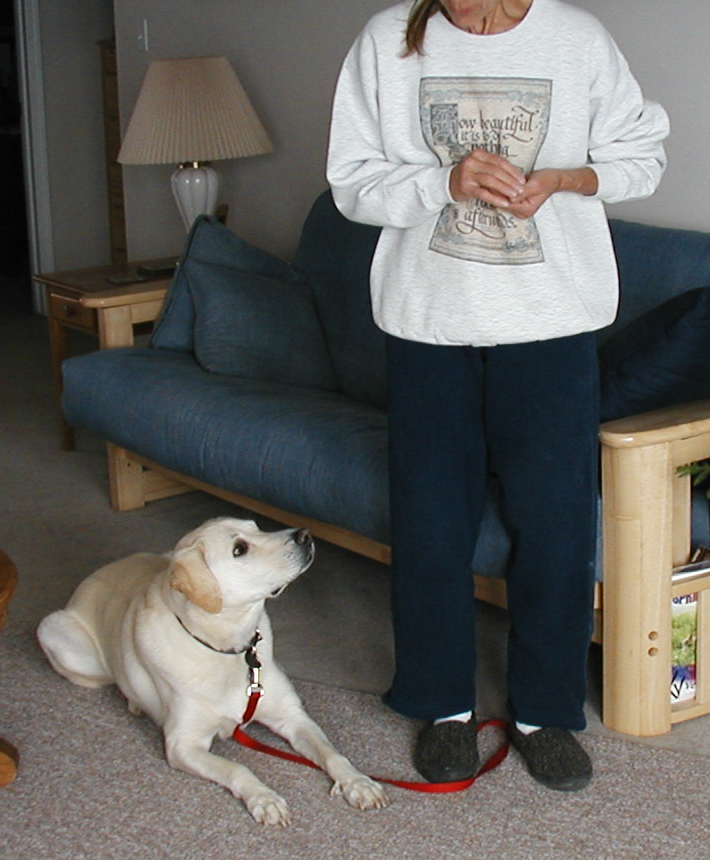
Chamois’ training started out great. The dog quickly learned to sit, down, and stay. Chamois walked well on the leash and was social with other dogs. But, over the years, things began to change. This happened incrementally. Chamois began to choose what commands to follow and how well to follow them. Soon this dog began to take control of the play. Chamois would no longer bring back toys and became very determined about winning every game of tug-of-war. When it came to getting affection from the owner, Chamois demanded that on her terms. She’d insist on being petted, and when the owner no longer wanted to pet the dog, Chamois would not graciously stop. All these uncorrected misbehaviors began to change Chamois’ perspective about who was in charge in the household.
One day, when Chamois decided the Miniature Pincher needed driven out of the house, she attacked the Miniature Pincher. Since the dog didn’t leave as Chamois had clearly communicated with the first attack, Chamois launched a second attack. If the owner hadn’t intervened, Chamois would have killed the Miniature Pincher. After the Miniature Pincher got out of the veterinarian hospital, the Miniature Pincher was rehomed.
Some people may be quick to cite the problem with Chamois as a result of this dog being dominant. My interpretation was that Chamois was a pushy dog (a descriptive term for her personality), and that pushy nature slipped under the radar of this dog owner. After all, this dog owner had successfully trained other dogs and not had this kind of problem develop. Where a pushy dog can get into issues is that after a dog learns to comply, the dog begins to push the limit of complying. An example of this may be that the dog hears you tell the dog to come, but the dog puts off complying until the dog feels like it.
With some dogs who wane in their compliance, this is just annoying and once the dog sets up this pattern of behavior the dog simply learns he or she doesn’t always need to obey. With a pushy dog, this becomes the first of many steps that puts the dog in charge. First, the dog gets lax about doing commands. Then the dog may become demanding about attention. Other behavior that may emerge include the dog controlling toys and managing playtime. Some dogs will progress to guarding food bowls or toys when the dog didn’t originally do this. A pushy-like nature can also be seen in some herding dogs, however I like to describe this as the dog being “insistent” rather than pushy about doing things the dog’s way. In the case of the herding dog, even if an animal kicks at the dog or charges a dog, the dog continues working the animal until the animal yields. This kind of insistence is fine if you want a dog to herd sheep, but not okay if the dog is persistent about doing things the way the dog wants instead of the way the owner wants.

I would like to emphasize that this attack had nothing to do with a dominant nature in this dog. The importance of this statement is that too often when people believe the dog is being dominant, people also believe that the dog needs put in her place to stop the aggression issues. Some may even try to use alpha rolls on this kind of dog to assert human dominance over what they perceive as a dominant dog. This is not the way to resolve this issue.
All pushy dogs will not develop the same kind of issue Chamois did. Some will only be annoying about wanting petting and never progress from that issue. Chamois tended to change her relationship with her owner over the years. As I mentioned, these changes were subtle enough the owner didn’t realize what was going on in the mind of the dog. With Chamois feeling more and more empowered, one day Chamois decided the Miniature Pincher needed eliminated from the household. One way to chase off another dog is to launch an attack to drive away the unwanted dog. This kind of problem was mentioned in Dog-to-Dog Aggression Part 1, when the situation happened with wolves a wolf rescue. Since both dogs lived inside a home, the Miniature Pincher, like the wolf at the rescue, could not flee the situation. To Chamois, this must have made her feel that she needed to take a stronger action because with the second attack, had the owner not intervened, would have killed the Miniature Pincher.
I was called in to help reform Chamois. Given the history of Chamois and the behavior issues I observed with the dog, I concluded from my experience how the situation had developed. I felt that this dog now saw herself in a position to make the decision she could eliminate the other dog from the home. I also knew, that to change Chamois’ behavior, I must work through each and every part of the areas where Chamois had taken control of privileges that belonged to the dog owner.
This process doesn’t involve trying to dominate the dog, or any use of punishment. Just as Chamois had incrementally taken charge, I knew I must incrementally take back control. That is what I did through a structured training plan. I then transition that training to the owner. Using step-by-step training taught Chamois that she could no longer attack the next dog who came into the home. You will find the section which shows the reform process with this dog is the largest one in my newest course Lessons in Fear and Aggression Part 4 – Training and Understanding the Reactive and Aggressive Dog
—
Resources
My award nominated DVD: Separation Anxiety, a Weekend Technique, is available to “view for free” during the month of March, 2020.
Here is the link: https://e-trainingfordogs.com/canine-problem-behaviors-peggy-swager-courses/
Dog to Dog Aggression-Part 3
by Peggy Swager
Dog to Dog Aggression Part 3: Shay’s Story Continued
Shay’s other aggression problem was a direct result of her becoming jealous of my interacting with Shilo instead of her. I know a lot of people debate if dogs can really feel jealousy. Call it what you want, but that was the way I saw it. I have included a short report on some research done on this topic.
Dogs are capable of feeling a basic form of jealousy, according to a study published in the PLOS ONE scientific journal. Science News
The research, said to be the first experiment on canine jealousy, could redefine the view that the complex emotion of envy is a human construct, said Christine Harris, University of California, San Diego psychologist and an author of the study.”
Shay attacked Shilo in my barn. The dogs both hung out with me while I did chores. Shay was wandering around, but not too far away. Shilo was closer to me, so I decided to have Shilo do a down on command. Shilo had struggled when I first got her when it came to sitting or laying down on command. Some would say she had a stubborn nature, due to the fact she was part Chesapeake Bar Retriever. When Shilo complied to my command, I gave her a treat, along with some very sincere praise and a pet. As soon as I straighten and took a step backwards, Shay rushed over and attacked Shilo. Of course, Shilo defended herself, and I had an all-out fight on my hands. Fortunately, I was able to break things up without any of us sustaining injury. Before this incident, both dogs got along very well making such an intense attack a surprise.
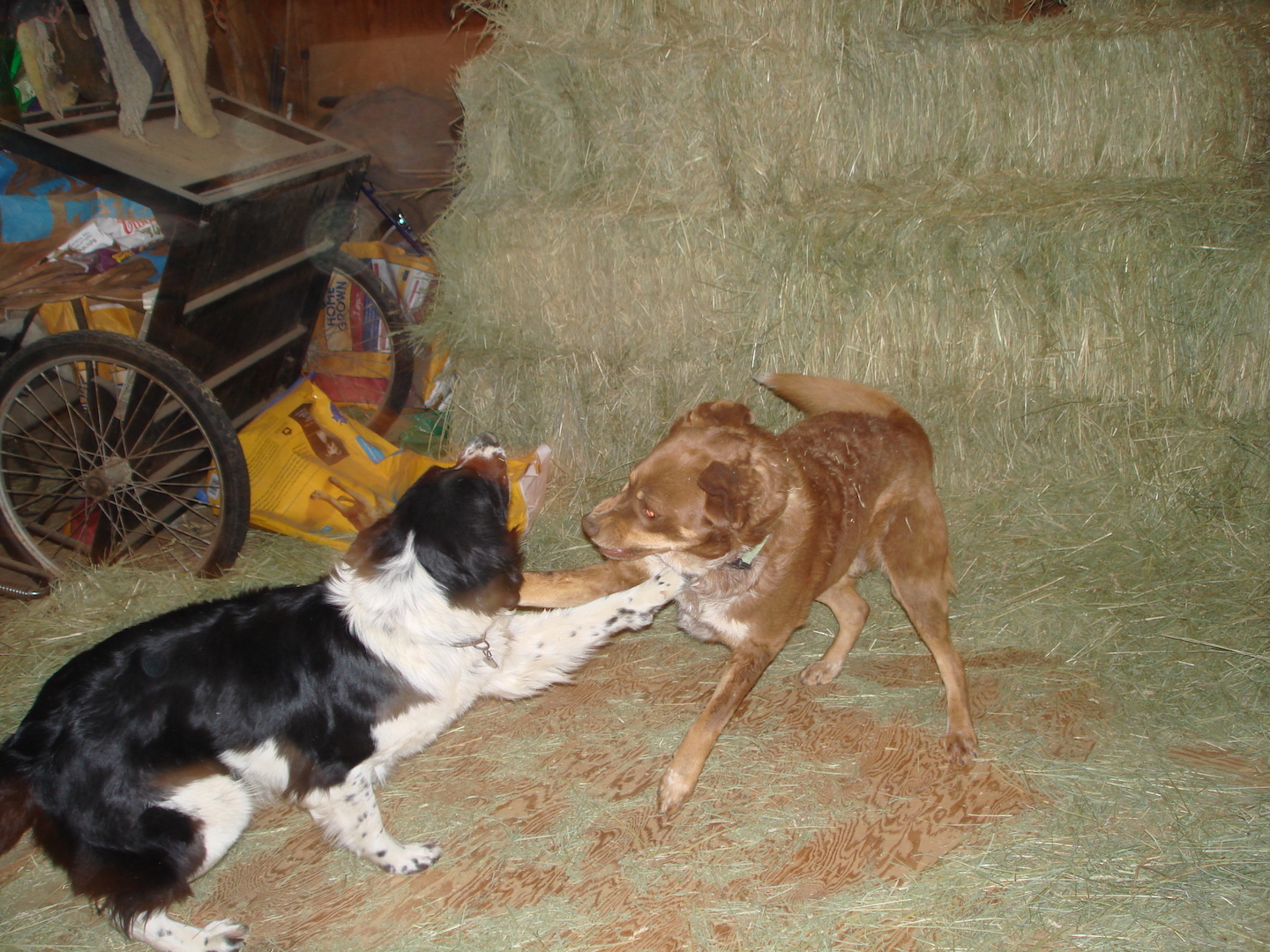
My conclusion was that Shay got jealous about me working with Shilo, especially since I’d given affection and praise. It appeared that Shay wanted to be the only dog I cared about. I had to get this dog to change a basic concept about who possessed who.
Since food was also involved in this attack, I had just given Shilo a treat for her compliance, I decided to start my reform training with Shay using food rewards. The first part of the training was to do the watch command. I’ve covered my preferred way to train the watch in both my book “Rescue Your Dog from Fear” and my one of my classes on Fear and Aggression.
I feel with the watch command that instead of just teaching the dog to look when I say “watch” I want the dog to choose to look at me, especially when the dog wants something. For that reason, I teach the dog to make eye contact both when I say the word “watch,” and when I hold a treat out sideways that the dog wants. The training, which requires the dog to choose to look at me when the dog wants something, makes this training more of a Premack approach.
I have found this approach to training the watch command very valuable when building compliance in a dog who struggles with compliance. Ironically, although Shay would comply all day long to a sit or down command, she struggled with the concept of possessions, and it appeared that she saw me as a possession. Since she wanted me as her possession, she didn’t want to share certain my affection with Shilo. Shay needed to learn that I controlled the affection she got, not her.
The second part of the training was to teach the Shay to “leave-it” and “get-it” on command. There are different ways to train this. My choice for training this is to teach the dog how to respond to a “leave-it” command when the dog is already trying to do a task the dog already wants to do, such as in the process of pursuing a treat I just tossed. I feel this kind of training helps a lot with impulse control. Shay was a quick study for both of these lesson.
When it was time to work these two dogs together, I had Shilo sit and stay nearby. I then did a practice of the watch and leave-it commands with Shay. After attaching a leash to Shay, I situated the dogs so that one was on each side of me, but at an angle so they were facing me. I again practiced the watch and leave-it commands with Shay. After putting Shay back into position, I told her “leave-it,” then reached out and handed a treat to Shilo. Any movement on Shay’s part was addressed by quickly stepping between the two dogs and asking Shay to “watch” me. When Shay looked at me, she received praise and a treat.
Shay took several practices with this kind of a drill for her to stop looking so disturbed about me handing over a treat to Shilo. I did try and help what looked like distress on Shay’s part by talking to her in an encouraging and calm tone. In the beginning, one or two acceptances of this feeding pattern was all I asked for. Afterward, I’d give Shay some affection for good behavior. After the training, I took both dogs for a short walk since they both liked this relaxing activity.
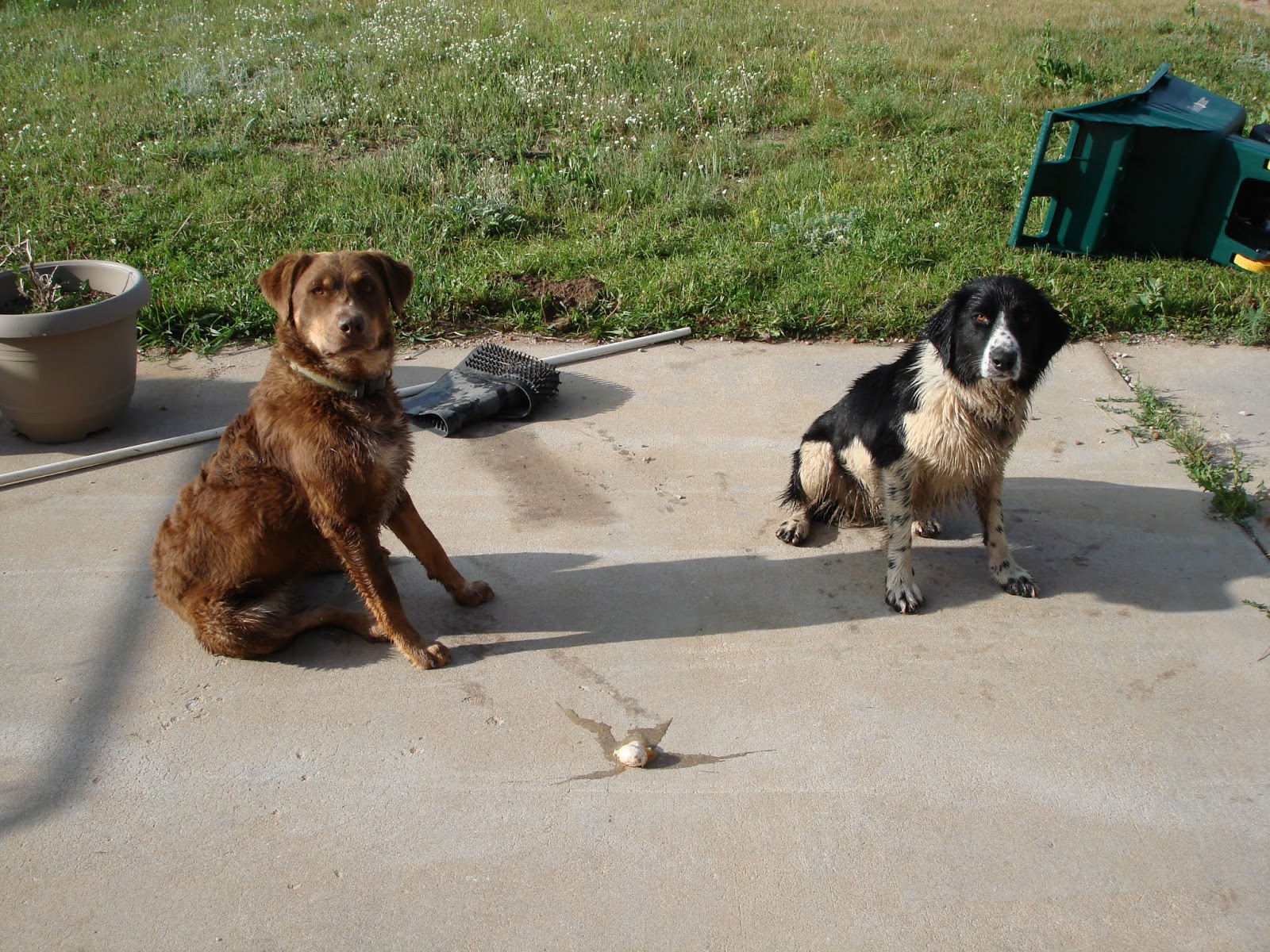
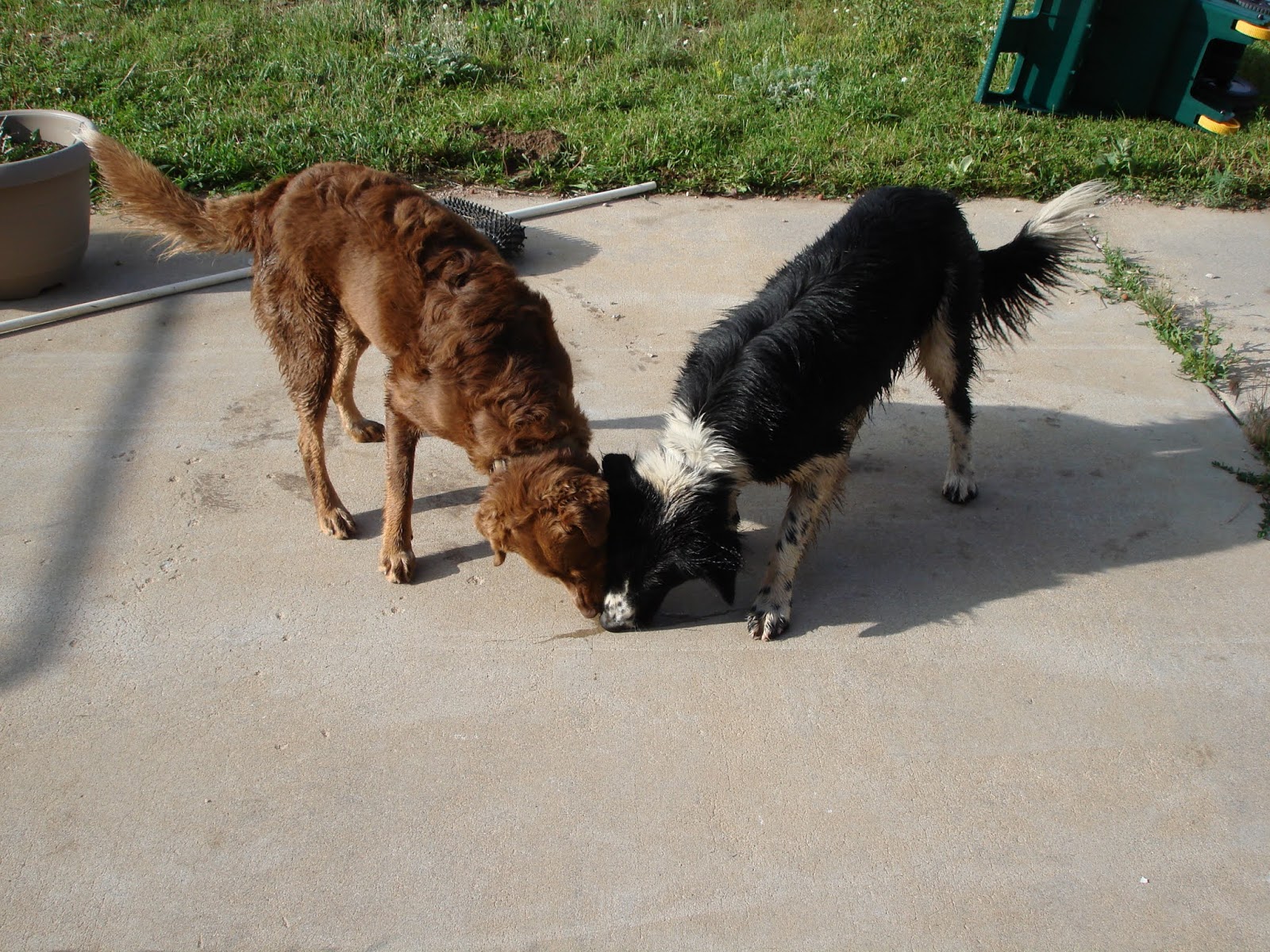
It took several sessions for Shay to begin to accept my feeding pattern. When Shay accepted me feeding Shilo first, I began to add praise to Shilo. Once Shay accepted me doing that, I added giving Shilo some affection. By breaking down each action into separate training, Shay was finally able to accept that I could give another dog the affection that Shay wanted to possess. As an added bonus, the additional training to resolve her jealousy issues also progress her food possessiveness from tolerating a dog eating nearby to the point where Shay could actually share food. The picture below shows how Shay learned to accept eating side-by-side with Shilo.
When the day finally came to re-home Shay, I knew I had to find owners who understood a sensitive and more complex dog. Most of Shay’s life had been spent with too much mistrust of people, and too many different homes. Shay needed the right family to continue the changes I’d made in the dog. Those people turned out to be Sue and John Ames. One of the most amazing things about their first meeting with Shay was how she warmed up to them right away, especially John. With my husband, it took a long time for Shay to feel comfortable with him.
Sue and John became Shay’s forever home. Her owners described Shay as energetic, playful, and very expressive. They commented that Shay was interactive in a very intelligent way, and more sensitive to their moods and attitude than any other dog. I always love it when one of my fosters finds her perfect forever home.
Resources
My award nominated DVD: Separation Anxiety, a Weekend Technique, is available to “view for free” during the month of March, 2020.
Here is the link: https://e-trainingfordogs.com/canine-problem-behaviors-peggy-swager-courses/
- 1
- 2
- 3
- 4
- Next Page »