e-Training for Dogs

Online Dog Training Class | Puppy Dog Training Online | Search and Rescue Dog Training

  • Home
  • About
    • History of e-Training
    • Faculty
    • Guest Lecturers
    • Students
  • Online Learning
    • For the Dog Professional
      • Canine Professional Programs
      • Individual Courses for Professionals A-Z
      • Individual Courses for Professionals-By Interest
      • Lecture Series
        • Ethology and Canine Behavior Lecture Series
        • Service Dog Training Lecture Series
      • CCPDT CEU Approved Courses
      • IAABC CEU Approved Courses
      • NADOI Accredited Courses for CEUs
    • For the Dog Enthusiast
      • Individual Courses A to Z for the Dog Enthusiast
      • Individual Courses by Interest for the Dog Enthusiast
    • Pet-Sitting Courses
    • Animal Wellness and Animal Hospice
    • Veterinary Professional Courses
    • Equine Enthusiasts Online Courses
  • FAQ
  • Blog
  • Contact
  • Links
You are here: Home / Archives for Professional Development Programs / Service Dog Training Course

Barbara Handelman Service Dog Trainer Course

October 12, 2021 By Cheryl Aguiar |

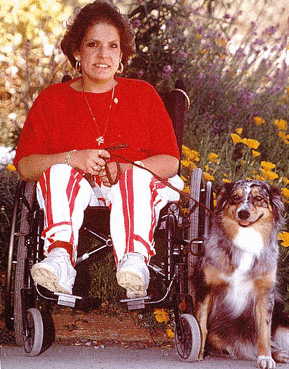
The Barbara Handelman Service Dog Trainer Course (BHSDT) is offered at three tiers (CURRENTLY ONLY TIERS 2 AND 3 ARE AVAILABLE). The tiers are designed to give access to the material commensurate with the students’ levels of interest and desire to attain competency.

service dog trainer

TIER 1

Tier 1 of the Barbara Handelman Service Dog Trainer Course (BHSDT Tier 1) is the most comprehensive course, designed for experienced professional pet dog trainers. This course has prerequisites and an application required before acceptance to the course. To learn more about Tier 1, including student expectations, a syllabus outline, and to download an application, please see…
****NOT CURRENTLY AVAILABLE****


Service dog trainer

TIER 2

Tier 2 of the Barbara Handelman Service Dog Trainer Course (BHSDT Tier 2) is designed for disabled handlers training their own service dogs, and for novice pet dog trainers. There are no prerequisites or applications required for taking this course. To learn more about Tier 2, including student expectations and a lesson outline, please see the BHSDT webpage here:

Barbara Handelman Service Dog Trainer Course – Tier 2

Purchase options for Tier 2:

Pay in full: $1,250 USD. Purchase HERE

A 9-month Payment Plan is available.

Payment per month (9 months) is $142.00 USD. Please click on the Subscribe Now button below.


 Tier 2 – must be completed in 9-months.

CEUs
CCPDT-21 CEUs

Please read our policy on refunds. Click HERE

TIER 3

Tier 3 of the Barbara Handelman Service Dog Trainer Course (BHSDT Tier 3) is designed for owner-trainers or anyone who would like to learn about service dog candidate selection, socialization, public access and task training. The Tier 3 courses are a la carte, each available for separate purchase, and each with different opportunities for continuing education units, if desired. To learn more about Tier 3, including a complete list of courses offered, please see the BHSDT webpage here:

Barbara Handelman Service Dog Trainer Webinars – Tier 3

Purchase any of the Tier 3 courses below (for more information on each webinar, go to the above link):

  • Laws Related to Service Dogs, $75 USD. Purchase HERE
  • Ethics and Etiquette for Service Dogs and Their Handlers, $55 USD. Purchase HERE
  • Stress in Service Dogs, $75 USD. Purchase HERE
  • What is a Service Dog Task?, $75 USD. Purchase HERE
  • Selecting Service Dog Candidates, $225 USD. Purchase HERE
  • Canine Cognition and Intelligent Disobedience, $65 USD. Purchase HERE
  • Video Training Journal: The First Year of a Service Dog Puppy-Candidate’s Life, $165 USD. Purchase HERE
  • Socialization, Public Access Training, and Public Access Challenges, $95 USD. Purchase HERE
  • Why Clicker Training for Service Dogs?, $65 USD. Purchase HERE
  • Clicker Train Your Own Assistance Dog, $175 USD. Purchase HERE

CCPDT CEUs –available for all webinars, see individual course pages.

Although information regarding the BHSDT program is on the Service Dog Trainer Education website, be assured that these continue to be E-Training for Dogs (ETD) courses. ETD will be hosting the courses, handling the payment arrangements, CEUs, and overseeing the Litmos platform for learning.

Please read our policy on refunds. Click HERE

Filed Under: Blog, Service Dog Training Course |

Barbara Handelman Service Dog Trainer Webinars – Tier 3

September 5, 2019 By Cheryl Aguiar |

Barbara Handelman Service Dog Trainer Courses for Everyone Interested in Service Dog Evaluation and Training

service dog trainer webinars

The a la carte (each available for separate purchase) service dog trainer courses in Tier 3 include abbreviated lessons from the BHSDT certificate program (Tier 1). The lessons are altered – there are no homework assignments, training challenges or critiques, nor opportunities for discussion as exist in Tier 1.

Instructors will answer brief, emailed questions about course content. Students wanting instructor input about selecting or training a service dog candidate may contract directly with a member of the BHSDT instructor-team for their time and services. Time with the instructors to answer questions about dog behavior or training problems may be purchased, on a fee-per-hour basis.

Included with the courses are abundant links to articles and other materials for self-study. There are quizzes required for those seeking CEUs.service dog trainer webinars

These a la carte service dog trainer courses are great for owner trainers wanting to expand their knowledge of service dog selection, essential service dog laws, training techniques, and other important topics in the service dog field.

The a la carte lessons are also excellent for Professional Service Dog Trainers and Coaches wanting to supplement their existing knowledge of key areas in the service dog field while earning CEUs.

Please note: Without instructor input, practical application and interactive critiques of the students’ acquired knowledge, these lessons do not qualify students to train service dogs for clients with disabilities.

service dog trainer webinars

What Students May Expect in The Tier 3 Courses

Access to lectures and other course materials developed by Barbara Handelman, for the three Tiers of this comprehensive Service Dog trainers’ program.

● Access to Collected References and Resources which include research studies; blog entries; lectures and videos available online; as well as published and unpublished papers by renowned individuals in the service animal industry.

Lessons Offered in BHSDT Tier 3

NOTE: Prices/Costs for the Tier 3 lessons vary based on the number and length of included lectures, as well as the depth and breadth of the reading materials and other resources offered with each lesson.

NO PREREQUISITES OR APPLICATION ARE REQUIRED FOR THE BHSDT TIER 3


Laws Related to Service Dogs                                

Cost: $75

Description: Understanding the laws and regulations applicable to Service Dogs is essential for all service dog trainers and handlers. Reading, understanding, and regularly reviewing these laws, policies and regulations is essential for any person training or handling a service dog. The laws covered in this Lesson apply to dogs and handlers in the USA only.

CEUs
CCPDT: 1 CBCC-KA or 1 CPDT-KA CEUs
IAABC: Pending

Ethics and Etiquette for Service Dogs and Their Handlers

Cost: $55

Description: This lesson will cover standards for a service dog’s behavior when working in public. Disabled handlers have ethical responsibilities to uphold the standards for the sake of their dog’s safety and welfare. They must also consider the impact of poor behavior on the businesses the dogs enter; and recognize that a poorly behaved service dog, in public, may make other service dog partners less welcome.

CEUs
CCPDT: 3 CPDT-KA CEUs
IAABC: 3 CEUs

What is a Service Dog Task?

Cost: $225

Description: A task is a chain of behaviors or skills performed in response to verbal, hand signal and/or contextual cues. Students will become familiar with a range of tasks they might train a dog to perform. Students will discover how tasks are different from the trainer’s perspective and the dog’s perspective. The component behaviors can be configured and reconfigured to comprise many different tasks. Contextual cues often vary but the dog must have sufficient cognitive plasticity to recognize similar contexts and perform the same set of skills in multiple situations. Students will learn that any task may be broken down into its component parts, and then the parts may be configured and reconfigured to create new tasks.

CEUs
CCPDT: 4 CBCC-KA or 4 CPDT-KA CEUs
IAABC: 4 CEUs

Selecting Service Dog Candidates

Cost: $225

Description: This course is an introduction to traditional temperament evaluations that have been modified by two highly experienced temperament evaluators who are also service dog trainers and animal behaviorists. Students will be exposed to protocols for necessary evaluation components, how to set up an evaluation session with a litter of puppies, or a single older dog, and how to rate the information gathered to determine the appropriateness of the puppy or dog evaluated to become a service dog in training.

  • This course also includes access to the two-hour video-on-demand “Selecting Canine Candidates for Assistance Dogs and other Working Careers.” CEUs available after quiz completion.

CEUs
CCPDT: 10 CPDT-KA (4 CBCC-KA) CEUs
IAABC: 10 CEUs

Canine Cognition and Intelligent Disobedience

Cost: $65

Description: This lesson is based on a webinar given by Barbara Handelman and Ken McCort. Together, they discuss whether “Intelligent Disobedience” is a myth or a reality in the daily activities of service dogs working for people with a wide range of disabilities. During this lesson, Barbara discusses how “intelligent disobedience” is defined and understood by service dog trainers. She debunks many myths, and explains how dogs learn a hierarchy of cues, and respond to them when multiple cues are present. Most importantly, she discusses the types of environmental cues that dogs recognize and follow, despite having been given a contradictory verbal directive. Ken McCort discusses how intentionality plays out in a dog’s response to verbal cues in the presence of contradictory environmental cues. He guides students through a basic understanding of a dog’s “Theory of Mind” or “Consciousness” – the ability to perceive himself in relation to his surroundings and the canine’s capacity for intentionality.

CEUs
CCPDT: 1 CPDT-KA and 2 CBCC-KA (3CPDT-KA) CEUs
IAABC: 

Why Clicker Training for Service dogs

Cost: $65
       

Description: Clicker training is a proven, successful method for training service dogs of all types. Clicker training is based on the science of Learning Theory. Students will read “Why Clicker Training for Service Dogs”, by Debi Davis and Barbara Handelman, in order to gain understanding of how and why clicker training is a preferred method for training service dogs. There is an extensive reading list for this class, each of the articles and blog posts illustrate how clicker training is utilized in the training of service animal foundation skills and tasks.

CEUs
CCPDT: 4 CPDT-KA CEUs
IAABC: 4 CEUs

Video Training Journal: The First Year of a Service Dog Puppy-Candidate’s Life

Cost: $165

Description: In this chronological video journal, students see many of the “formal” training sessions from Puppy Pan’s first year of life. The videos are narrated throughout with explanations of the training documented. Errorless learning was always the aim of training – frustration was minimized and playful interaction was emphasized. Training sessions were short and a playful time with a purposeful goal. This journal provides a rare opportunity to see how learning occurs sequentially, in small, incremental steps, with lots of repetition, and equal opportunities for positive reinforcement. Training sessions progress from basic targeting behaviors to application of targeting into complex chained behaviors that ultimately become service dog tasks. Students will watch how the foundation behaviors are built, how the 4 D’s (Distraction, Duration, Distance, and Difficulty) are applied to strengthen the puppy’s learning, and how chained behaviors are built and reconfigured to become a variety of service dog tasks. The behaviors taught include the multi-step process of building a working retrieve. By watching one puppy develop through training and maturation, over the course of a year, students will see how an experienced trainer uses treat delivery and rate of reinforcement to strengthen behaviors. Students will also see how errorless learning decreases frustration, and allows training to become an interactive and creative game for the trainer and puppy to play together.

I really enjoyed watching Pan’s training year in video. It was fun to watch him problem solve the individual sessions and eventually get to the point of learning the complex tasks. Starting from the beginning and seeing him start with nose targeting the hand, transferring that skill to the stick and then generalizing similar skills to his feet shows how those vital foundation behaviors can be taught and generalized through clicker training. That by individually teaching the dog to think through the scenarios without much input from the handler is vital to creating a dog who can problem solve. The videos also depicted lots of work building difficulty of individual tasks, around distractions, working at distance, and adding duration. It was fun to see Piper’s responses to the larger animals, and Pan having to work around children and food at the farmer’s market. The video of Pan building his working retrieve was a great way to view the chaining of individual skills, and then to see that transfer over and build with targeting for him to take things from you to deliver to someone else and then deliver back to you. I found Pan’s puppy frustration very interesting with the push top ball toy. It was a valuable lesson to see how being aware of how long your sessions with a dog run for as well as how you reinforce them while making things more difficult or increasing the criteria without losing their interest. It was interesting to hear how Pan’s love of balls never transferred over to a full love of a playing retrieve, and that his retrieve really was all about work for him. And you could definitely see how a very strong desire to hand target is an extremely important component of teaching a working retrieve. Colleen Lange – BHSDT Tier 1 Student.

CEUs
CCPDT: 8 CPDT-KA CEUs
IAABC: Pending

Socialization and Public Access Training

Cost: $65

Description: Many people confuse socialization with socializing. Socializing with an occasional visiting dog in the pup’s home, or local environment is not enough. Taking a young puppy to a dog park, turning it loose to be approached by bullying dogs, and pushy puppies – would qualify as socializing, not socialization. This class introduces the concept of socialization; when it should begin; and how it continues throughout the life-time of a working service dog.

CEUs
CCPDT: 2 CPDT-KA and 4 CBCC-KA (6 CPDT-KA) CEUs
IAABC: 6 CEUs

Clicker Train Your Own Assistance Dog

Cost: $175

Description: There is no single cloak to be woven from the many threads in this “train your own assistance dog” course. It does not focus on demonstrating completed or polished tasks. Rather, the focus is on the ingredients – the behaviors the dog must know in order to construct tasks, lots of tasks. Assistance dogs serve individuals with such diverse disabilities that no single educational tool could encompass all the steps for creating finished assistance dog tasks – to serve the full range of disabilities. Specific tasks often need careful tailoring to individual teams, and differ with variables like the relative size of the dog to the handler. This is a four-part series of videos providing 4 hours of training demonstrations to watch. There are verbatim scripts that come with the Videos On Demand. The scripts allow those who are deaf or hard of hearing to read all spoken narration that accompanies the training demonstrations.
Access: Once you purchase the Clicker Train Your Own Assistance Dog modules, you can begin watching the videos-on-demand immediately. If you would like open-ended access to this video-on-demand series, you may purchase that option at any time, for an additional $20.

Karen Pryor’s review of Clicker Train Your Own Assistance Dog
This is a unique and wonderful program for learning how to clicker train the essential skills that make a good service dog. This course is presented on four video DVDs and includes a downloadable text manual. Each scene includes on-screen script for the hearing impaired, and simultaneous narration for the visually impaired. This program is for people with impairments, perhaps in wheelchairs, who are using a service dog. Barbara Handelman shows you how to turn that dog into a superb partner and assistant, through your own training. The program assumes your dog has basic obedience skills – sit, down, come, a retrieve—but it does not assume that you are a clicker trainer. That, she will show you, click by click. Barbara has taken a set of key foundation behaviors and cues that underlie every behavior a service dog can do. She shows you how they are actually shaped, via clicker training. The text is pared down and crystal clear. It’s available on a file you can print out, to make an illustrated manual. It’s also narrated, in the DVD, for the visually impaired, and written, over the action, for the hearing-impaired. The program is not broken down by end products, but by skills. Each skill section begins with clips from the first brief training session, then the second, third, fourth, with actual working service dogs being trained by their actual owners. For example we see a dog learning the behavior and the cue ‘take,’ for picking up, holding, and carrying large objects in its jaws—a dumbbell, a newspaper—and then the behavior and the cue ‘pick’ for gently picking up a pair of glasses or a credit card with its lips and front teeth. Once the skills and their cues are learned, you can combine, say, ‘Pick,’ and a previously learned ‘Pull,’ point at your feet, and the dog can immediately take your socks off. You can skip around in the DVD’s, the program is all broken down into scenes. Go back and forth, or play one scene over and over, to get the timing. Notice, as you do that, how still and calm the teachers are. There are no wasted moves, no dog-confusing chatter. Barbara explains exactly why we are quiet as we train; and exactly why there is no need for correction or reprimands. In addition to being a great self-teaching course, this program is a lesson in the multi-leveled benefits of clicker-training for developing a happy, reliable, service dog that can continue to learn all its life.

CEUs
CCPDT: 7 CPDT-KA CEUs
IAABC: 9 CEUs

For Tier 1 and 2, please use these links:

Tier 1 – Barbara Handelman’s Service Dog Trainer Course for Professional Trainers (not currently available)

Tier 2 – Barbara Handelman Service Dog Trainer Course for Novice Owner-Trainers or Pet Dog Trainers

Filed Under: Service Dog Training, Service Dog Training Course |

Working with Service Dog Owner-Trainers: It’s Not About the Dog

August 16, 2018 By Cheryl Aguiar |

Working with service dog owner-trainersWorking with Service Dog Owner-Trainers – Clients

Are you getting calls from clients asking for help training their own service dog? Are you wondering whether to take these cases or refer them out? Working with service dog owner-trainers can be both challenging and rewarding.

From the initial inquiry, to consults, lessons, and a long-term training relationship, working with service dog owner trainers (OTs) can have significant differences from working with pet dog clients. Quite apart from dog-training expertise, OT cases may require us to navigate tricky legal, business, human health, psychological, and community considerations. Pet dog trainers may find this work rewarding, challenging, overwhelming, confusing, or distasteful. Trainers who take on service dog clients without adequate preparation may cause unintentional psychological or physical harm to the client team or damage to their business. This presentation will address some of these differences and help you decide whether this work appeals to you.

Speaker: Sharon Wachsler, CPDT-KA, KPA-CTP  and Barbara Handelman, M.Ed., LCMHC, CDBC, (Moderator)

Access to the recording is for 32 days.

This presentation will address trainer questions such as:

  • Should I offer pre-adoption consulting and assessment to help clients find candidate dogs?
  • How do high levels of chronic stress/distress in the client’s life affect the dog-client-trainer relationship and approach?
  • Should I modify lesson, package, and billing structure to provide OTs additional support?
  • How do SDiT training standards differ from pet standards in terms of choosing behaviors or level of handler skill or reliability?
  • How familiar and comfortable do I need to be with mental and physical disabilities? What is disability culture and etiquette? How do I help clients choose assistance tasks?
  • Am I ready to cope with more “high-maintenance” clients? Am I prepared to set up progress meetings, meetings with client’s healthcare providers, or offer support between lessons and work with clients on a weekly basis for years?
  • How should I adapt training equipment and methodologies for the handler’s disabilities?
  • How should I prepare to address topics like career change (“washout”), rehoming, and/or retirement?

We’ll also address common trainer questions such as:

  • How do you know if the client is truly disabled and needs a service dog?
  • How do you proceed when the dog needs training but is an inappropriate SDiT prospect?
  • Is there a way to work with clients whose physical or mental disabilities pose barriers to your usual training instructions or methods?
  • When and how to turn away a client or refer them to another trainer?

By the end of this workshop, participants will have a better sense of what working with service-dog owner-trainers may require of them, whether they are interested in delving into this specialty, and if so, how to choose which cases to take, and how to refer cases that are not a good fit.

Cost: $25.00 USD

CEU’s Available:
2 IAABC CEU’s
2 CCPDT CEU’s
2 ABCDT-L2 CEU’s
2 NADOI CEU’s
2 PPAB/PPG

Filed Under: Service Dog Training, Service Dog Training Course |

Roles of Dogs in Society

April 21, 2015 By Cheryl Aguiar |

Roles of Dogs in SocietyRoles of dogs in Society: Assistance dogs, service dogs, emotional support dogs, therapy dogs, and companion dogs

Dogs’ roles in society are expanding, whether as companions or assuming special roles for assistance or therapy by volunteers or human health professionals.  Many changes are appearing in new research findings and evolving regulatory and legislative updates around the roles of dogs in society. Animals’ psychosocial effects for people rest on theoretical perspectives with associated physiological and psychosocial processes. And, practical applications of human-animal interactions for therapy or enhanced quality of life continue to increase.  One complication is the inconsistent vocabulary used for assistance, service and therapy dogs’ roles for vulnerable people. Whatever their specific roles, animals can offer psychosocial benefits: normalize and enhance quality of life by alleviating loneliness or depression for those with mental illness or disabilities, increase social interactions, motivate people, and improve physiological health with calming effects.  Animals increasingly in the U.S. offer personalized assistance or emotional support, especially dogs; various species can provide a nexus with the person’s needs, with access permitted in housing and transport.  Recent robots imitate the actions of assistance dogs or emotionally-supporting animals. One next step is for health professionals to deliver personally targeted and tailored treatments.

Speaker: Lynette A. Hart, Ph.D.

Learning objectives:

  • Legislative and regulatory provisions in the U.S. regarding “service dogs” (the inclusive term)
  • The importance of the service dog to the person, and factors affecting the relationship
  • Specified criteria for training and placement to gain accreditation from Assistance Dogs International (ADI)
  • Requirements of some federal agencies and some facilities, e.g., the U.S. Army, the U.S. Veterans Administration, for allowing and supporting service dogs
  • California’s approach to service animal registration
  • Uses of canine companionship in legal settings
  • Differences between ADI-trained “facility dogs” of working professionals, and “therapy dogs”

Recorded live, now available as a recording.

Cost: $25.00

add-to-cart-8


CEU’s Available:
2 IAABC CEU’s
2 CCPDT CEU’s
2 ABCDT-L2 CEU’s
2 NADOI CEU’s
2 PPAB/PPG

Members of APDT, CCPDT, IAABC, ABCDT-L2 or NADOI receive over 25% off.All Lecture Series Webinars are only $18.00 each. See instructions below on how to find the password to take part in this professional discount.

IAABC members, Click HERE to apply your discount.
Email cheryl@e-trainingfordogs for the passcode.

NADOI, CCPDT, ABCDT-L2, PPG, IACP and APDT members, click HERE to apply for your discount.
Email cheryl@e-trainingfordogs for the passcode.


Filed Under: Past Lectures, Service Dog Training Course |

Search this site:

SIgn up for our Newsletter

Sign up for our newsletter: Sign up for our newsletter

Follow Us

  • Facebook
  • LinkedIn
  • RSS
  • Twitter
  • YouTube

Link to Discounted Courses for Professionals

Link to Discounted Courses for Professionals

Link to Classroom For Current Students

Link to classroom: Student Classroom Link This link will work for current and registered students ONLY.

Lecture Series

Seeing Through a Dog's Nose-Canine Nose Lecture Series ALSO, Please check out our ethology and canine behavior lecture series, over 100 lectures Ethology and Canine Behavior Lecture Library Also available is our lecture series: Service Dog Training Lecture Series

What is E-Training for Dogs and how does it work?

What’s NEW?

CPDT-KA Attestation Form online signature

Training the Retrieve

Emotional and environmental enrichment with scent

Backing and Pivoting

The Science of Olfactory Perception and Learning

Pay Later Now Available

What’s NEW?

CPDT-KA Attestation Form online signature

Training the Retrieve

Emotional and environmental enrichment with scent

Backing and Pivoting

The Science of Olfactory Perception and Learning

Copyright © 2026 e-Training for Dogs | Privacy Policy