Seeing Through a Dog’s Nose – Canine Nose Lecture #2
Title: The Science of Canine Olfactory Perception and Learning
Speaker: Dr. Simon Gadbois (see bio below)
Description:
Olfactory processing from an integrative perspective: Neurobiology, evolution, ecology, and psychophysics
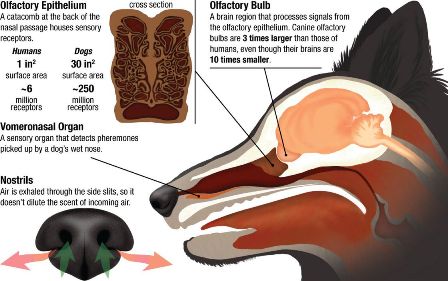
Olfaction, in the evolutionary context, has two main functions: Finding food and finding mates. It is not surprising that olfaction is consequently closely tied to the reward and anticipation systems of the brain. Olfaction is also multidimensional, and from a “cognitive” perspective (strange word to use for a post-cognitivist, but bear with me), it comprises a number of different processes that are arguable tapping into different parts of the brain and tackle different survival functions. We will start by discussing the biological foundations of olfaction (neurobiology, evolution, ecology) and will then proceed to discuss the rarely discussed (and yet very active) field of olfactory psychophysics and the methods that are relevant (and also mostly ignored) to olfactory processing. Examples from Gadbois’ areas of research in olfaction (with canines particularly, but also with molluscs, fish, and reptiles) will be discussed in the context of wildlife conservation canines and biomedical detection and diagnosis canines.
Learning Objectives:
- The neurobiological foundations of olfaction: The brain systems
- The ecological foundations of olfaction: Finding food and finding mates
- Olfactory motivology: How learning and olfaction are tied
- The old olfactory psychophysics meets the needs of the modern scent dog
- Advanced section: Signal Detection Theory
Available as a recording
Access to the recording is for 32 days after the webinar and is available for both Live and Recorded attendees.
Cost: $25.00 USD

CEU’s:
CCPDT – 2
IAABC – 2
PPAB/PPG – 2 CEUs
NADOI – 2 CEUs
IACP – 2 CEUs

Simon Gadbois, Ph.D.is a researcher in animal behaviour and behavioural neuroscience at Dalhousie University, Halifax, Canada. Early in his academic career he integrated biology (ethology), experimental animal psychology and neuroscience within a post-cognitivist perspective. A true generalist, he has studied olfaction, learning/memory and social behaviour in species of insects, molluscs (slugs and snails), fish, reptiles, birds (pigeons) and mammals (rats, dogs, red foxes, coyotes and wolves). He has studied wild canids for over 20 years and established the Canid and Reptile Behaviour and Olfaction lab at Dalhousie in 2006, a year before the closure of the Canadian Centre for Wolf Research. There he had studied the behavioural endocrinology of social behaviour in wolves and behaviour patterns in foraging behaviours comparatively in foxes, coyotes and wolves. Since 2007 his lab is engaged mostly in research on biomedical detection, diagnosis and assistance as well as tracking and trailing of species-at-risk with his wildlife conservation canines. The lab has a strong applied and methodological focus.
 Seeing Through a Dog’s Nose – Canine Nose Lecture #1
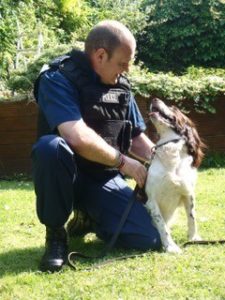 Speaker: Dr Robert Hewings, BSc MA, the author of the soon to be published ‘Introduction to Canine Scent-Work’ and head of learning and development for the UK College of Scent Detection, Dr Robert Hewings is a highly experienced Canine Trainer. He retired from the Metropolitan Police after 30 years’ exemplary service, 25 of which was as a Police Dog Handler. The final nine years as a full-time trainer with the Metropolitan Police Dog Training Establishment. He has enhanced this experience with a BSc (Canine Training and Behaviour) MA (Professional Practice Police Dog Training) and a Doctorate of Professional Practice (PhD) Canine Scent Detection. Rob has instructed all police canine-search disciplines including explosive search and narcotics, supporting this with practical experience gained in London UK where he has supported many large events, the 2012 Olympics, Wimbledon Tennis and protecting our Royal Family.
 After his retirement in 2016 Rob, took on new challenges to complete his desire to learn, lecturing at university (BSc Canine Behaviour and Training) where he specialised in ‘Assistance Dog Training’, writing his recently published book, and practical assistance dog training using scent-work within epilepsy alert, diabetes alert and Post Traumatic Stress Disorder alert. He also attended Bergin University of Canine Studies where he gained a valuable insight into assistance dog training, particularly for PTSD sufferers.
 The Seeing Through A Dog’s Nose lecture series at E-Training For Dogs is offered for professional trainers; owner trainers; scent work enthusiasts; scent detection service dog trainers/owners; medical detection dog trainers/owners; Search and Rescue (SAR) dog trainers/handlers; and anyone else with an interest in the canine nose. This canine nose lecture series on canine olfaction provides participants an opportunity to sample the expertise of a diverse selection of highly acclaimed experts in the many fields of dog training and research where the canine nose and its fantastic abilities is the area of interest.
 Christina de Juan, Ph.D., CPDT-KA, one of the series’ moderators, is the owner and trainer at Luna Service Dogs Inc. Christina and her dog Luna began scent training in 2012 in the sport of NACSW K9 NoseWork®, where she found her passion in studying canine olfaction and body language. Luna went on to become the first Klee Kai to earn a NoseWork title with NACSW, and later her personal gluten detection service dog. Christina is a founding member and Vice President of O.D.O.R. Service Dogs Inc., an educational nonprofit organization dedicated to ensuring scent detection service dogs are trained to the highest standards and demonstrated reliability. She is also Certified in Low Stress Handling®, an AKC CGC Evaluator, an APDT C.L.A.S.S. Evaluator/Instructor, a PPG PDA Assessor/Instructor, and an O.D.O.R. Evaluator.
 Canine Olfaction webinar