e-Training for Dogs

Online Dog Training Class | Puppy Dog Training Online | Search and Rescue Dog Training

  • Home
  • About
    • History of e-Training
    • Faculty
    • Guest Lecturers
    • Students
  • Online Learning
    • For the Dog Professional
      • Canine Professional Programs
      • Individual Courses for Professionals A-Z
      • Individual Courses for Professionals-By Interest
      • Lecture Series
        • Ethology and Canine Behavior Lecture Series
        • Service Dog Training Lecture Series
      • CCPDT CEU Approved Courses
      • IAABC CEU Approved Courses
      • NADOI Accredited Courses for CEUs
    • For the Dog Enthusiast
      • Individual Courses A to Z for the Dog Enthusiast
      • Individual Courses by Interest for the Dog Enthusiast
    • Pet-Sitting Courses
    • Animal Wellness and Animal Hospice
    • Veterinary Professional Courses
    • Equine Enthusiasts Online Courses
  • FAQ
  • Blog
  • Contact
  • Links
You are here: Home / Archives for Blog

Canine Behavior 101

November 18, 2020 By Cheryl Aguiar |

This one hour webinar is designed as a brief, but thorough, introduction to Canine Behavior.

Starting with the history of dogs and humans, through critical stages of development and how that impacts behavior, to actual understanding canine behavior, this course will serve as a great primer for anyone working with dogs.

A Certificate of Completion is available on completion of the webinar and a short quiz.

Covered in this webinar:

  • Domestication
  • Development
    • Physical
    • Behavioral
    • Social
  • Body Language
    • Distance increasing
    • Distance decreasing
    • Stress / displacement
    • Physical characteristics that inhibit communication

Cost: $25

Filed Under: Blog |

Canine Behavioral Euthanasia

May 27, 2020 By Cheryl Aguiar |

canine behavioral euthanasia

What is canine behavioral euthanasia, which problems are beyond help, and how can we best support clients or vet/shelter/training staff who are grieving this special kind of loss? 

Some schools of thought believe that all dogs can be saved, no matter how difficult or dangerous their behavior problems might be. Sadly, this is not true. Some minds are beyond help. The bullying that happens after a canine behavioral euthanasia might cause people grieving such a traumatic loss to lie about what happened to their dog, which makes those of us who have traveled this sad path feel even more alone. 

Trish and Sue will also touch on the issues around what happens when behavioral euthanasia is not on the table, and how we, as professionals, might help change attitudes and combat bullying in order to better support colleagues and clients.

Available as a recording.

Register Here:
$25.00 USD

Speakers:
Sue Alexander CPDT-KSA, CBCC-KA, CDBC
Trish McMillan, MS, CDBC, ACCBC, CPDT-KA 

This talk covers:

  • Behavioral euthanasia is a thing

  • Not everyone supports it

  • Why we need to change this

  • How we might change this

  • What happens when we don’t BE (behavioral euthanisia)?

  • Next steps

CEU’s Available:
2 IAABC CEU’s
2 CCPDT CEU’s
2 NADOI CEU’s
2 PPAB/PPG


Members of APDT, CCPDT, IAABC, PPG/PPAB or NADOI receive over 25% off. All Lecture Series Webinars are only $18.00 each. See instructions below on how to find the password to take part in this professional discount.

IAABC members, Click HERE to apply your discount.
Email cheryl@e-trainingfordogs for the passcode.

NADOI, CCPDT, PPG/PPAB, and APDT members, click HERE to apply for your discount.
Email cheryl@e-trainingfordogs for the passcode.

Filed Under: Blog |

Retired Service Dogs as Mentors

April 18, 2020 By Cheryl Aguiar |

By Barbara Handelman M.Ed., CDBC

 “Dogs don’t learn by observation” was a myth promulgated as truth when positive punishment (P+) training methods solidly dominated professional dog training circles.  Back then, most trainers believed that dogs learned what trainers set out to teach them.  Few discussed other ways dog might learn, certainly not by observation, or error-free reward-based training.

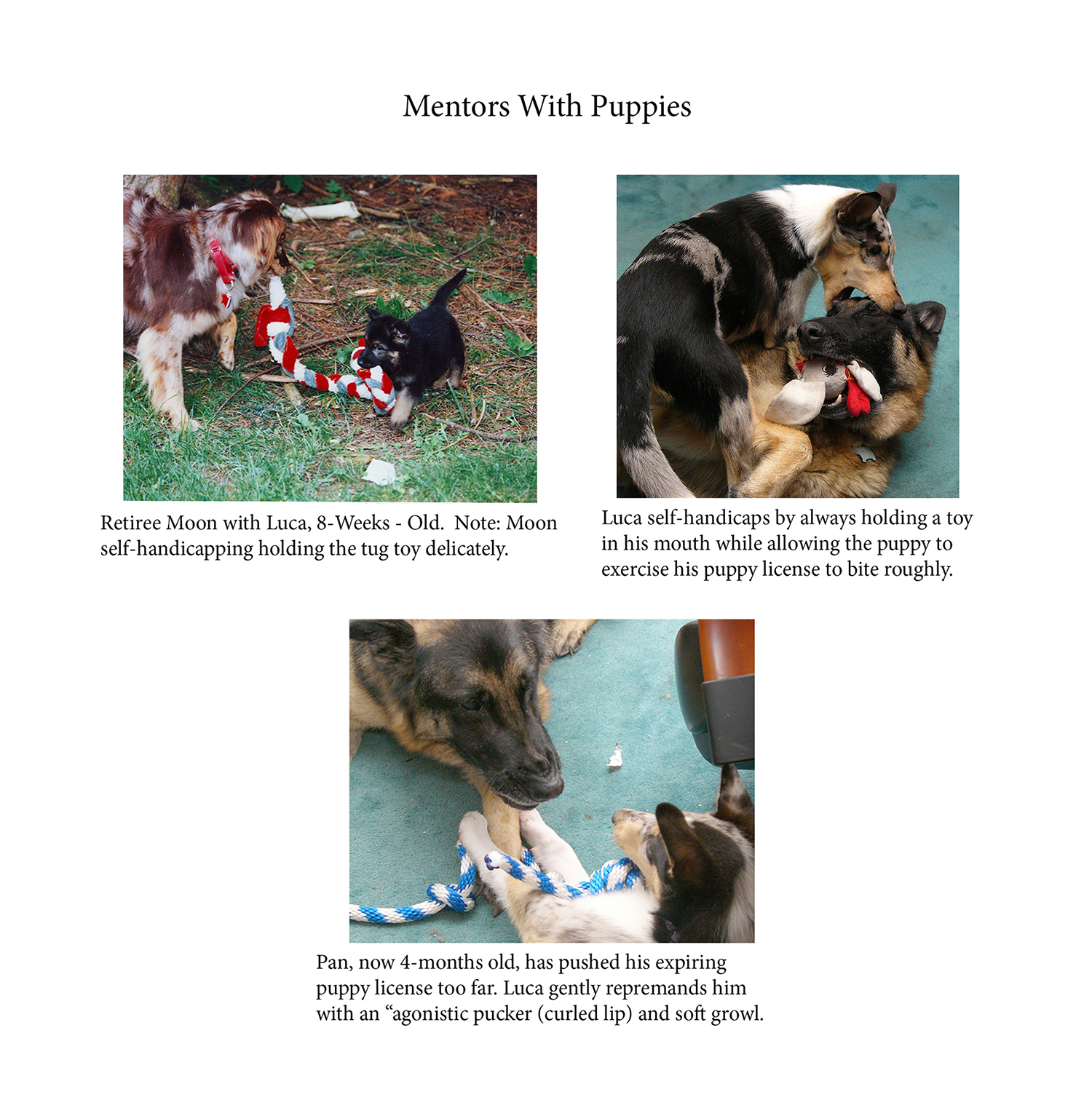
My Australian Shepherd, Moon, began retiring from his service dog career after only four-short years, due to stress while on the job. Moon remained my agility partner for years to come. He also patiently transitioned to a new job as a puppy raiser. Luca, an 8-week-old German Shepherd puppy became Moon’s successor as my service dog, and greatly benefited from Moon’s mentoring.

Moon watched Luca’s task training sessions intently. During a session when I began training Luca to target and then push up a light switch with his nose, Moon watched each repetition Luca made and for which he received a click and a treat.  Moon was highly food motivated, and eagerly participated in any activity that garnered treats.

Moon’s turn with the light switch followed immediately after Luca’s.  When I presented the light switch to Moon for his first attempt, he began just where Luca had left off.  Moon required none of the successive approximations Luca had practiced to get to his ending point.  It was clear that Moon had not only observed Luca, but he learned a new skill through observation.  Such observational learning remained Moon’s specialty throughout his life.

There are many advantages to raising a puppy in a household with a socially adept older dog.  Dog-to-dog rules of engagement learned first from their mother and then among littermates often continue on within a multi-dog household. Older dogs also “self-handicap” in order to not injure puppies during rough and tumble play. They titrate the pressure of their mature jaws in order not to hurt a pup while jaw wrestling, and they’ll pull with less vigor in order to keep a game of tug going and not frighten or overwhelm by pulling the little one off his feet.  As puppies mature, older dogs will gently correct with modulated force or vocalization the pup who bites hard enough to hurt.  The presence of an older dog, who models appropriate canine body language helps the puppy develop his own interactive expressive vocabulary.  Becoming well-versed in the art of “speaking dog” serves the pup for a lifetime among dogs in his ever-expanding community.

Retiring service dogs can effectively teach service dog behavior and etiquette by modeling appropriate behavior during public access outings.  Most puppies raised without a canine mentor, must wait until they are 5-to 6-months-old to develop the self-control with which to venture into restaurants or doctors’ offices.  Working a seasoned service dog in tandem with a young puppy can begin when an appropriate pup is only 3-4 months-old.                 

Taking such young puppies out into the community requires extra vigilance on the part of the handler.  When he was only 12-weeks old, I took Gusto to a familiar local restaurant, long accustomed to welcoming the presence of my older working dogs.  During these outings, I always parked near an entrance, and sat at a table near the same door, so that if Gusto was restless or otherwise required a hasty, unobtrusive, retreat it was easy to accomplish.
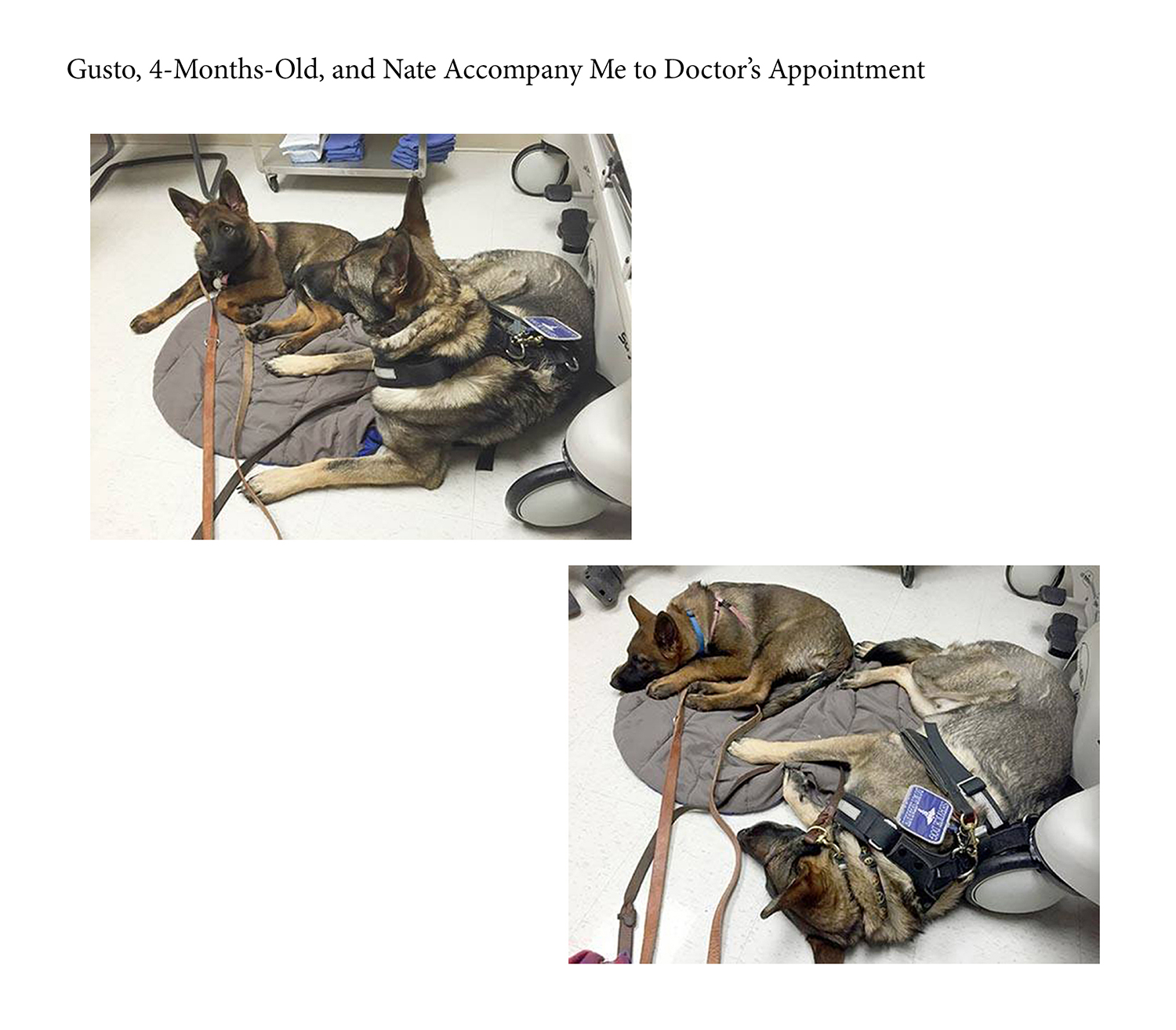
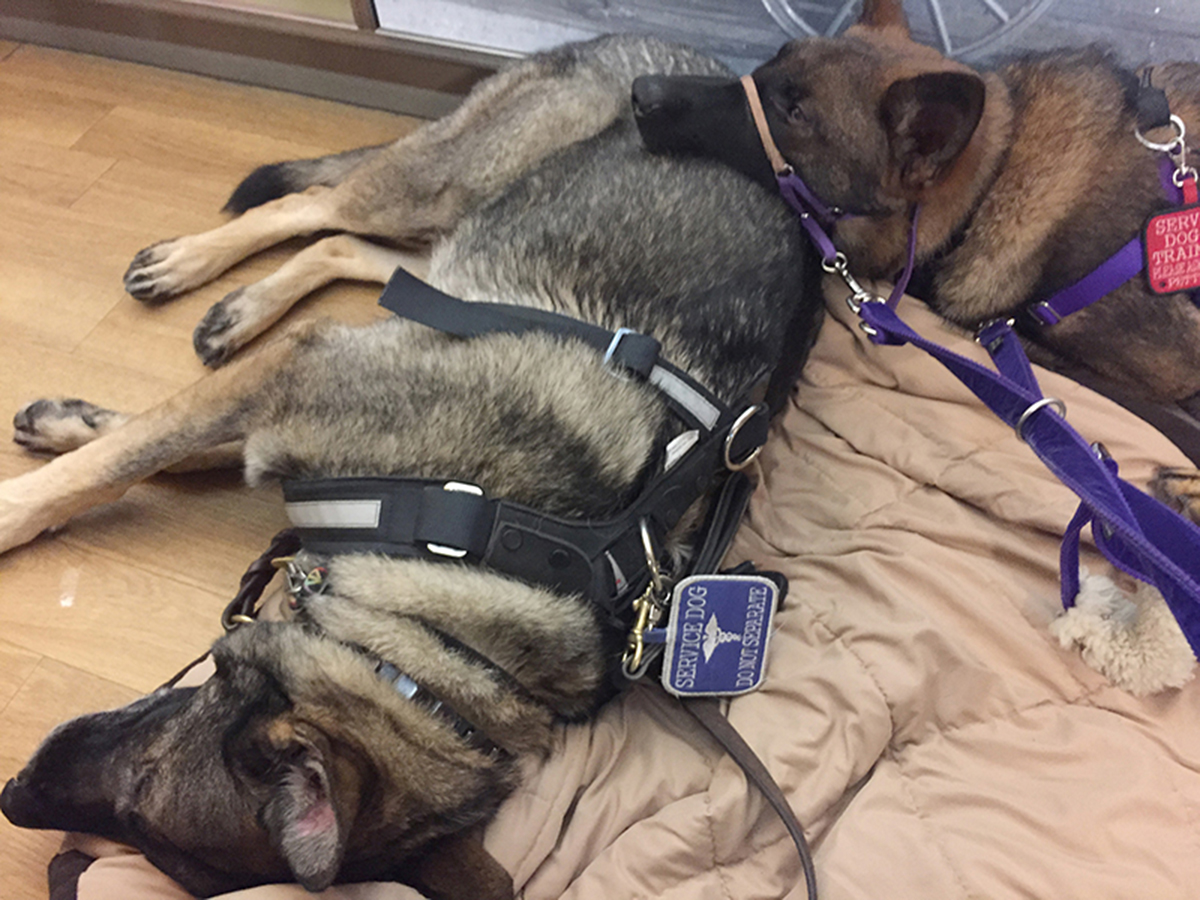
Handlers venturing out with young puppies must ensure that a puppy has had ample time and opportunity to adequately eliminate before entering a place of public accommodation.  If a pup becomes restless, be prepared to take them outside quickly, or have supplies along for a quick and complete cleanup.  If the pup shows any signs of stress, leave immediately and return to pay without the pup if necessary. 

If the pup seems alarmed by noise, crowds, running or crying children, strangers approaching, service carts rattling past, quickly leave with the pup. Be aware of fear periods that come and go.  It is unwise to pressure a puppy to habituate to frightening sites or sounds, especially not during a fear period.  Classical conditioning, practicing something familiar and calming, in the form of offering special treats, may be useful if the pup is simply startled. Give the pup a chance to recover quickly. However, if the pup won’t accept a favorite treat, that is a certain indication that they are too stressed to stay in the situation.  Best to calmly but quickly remove them from the environment.

I have never found a more effective way to build confidence in a puppy than the presence of an older dog who models calm in unfamiliar, crowded, or noisy environments.  Most puppies simply absorb the adult dog’s relaxed attitude and mirror the calming body language their mentor models.           


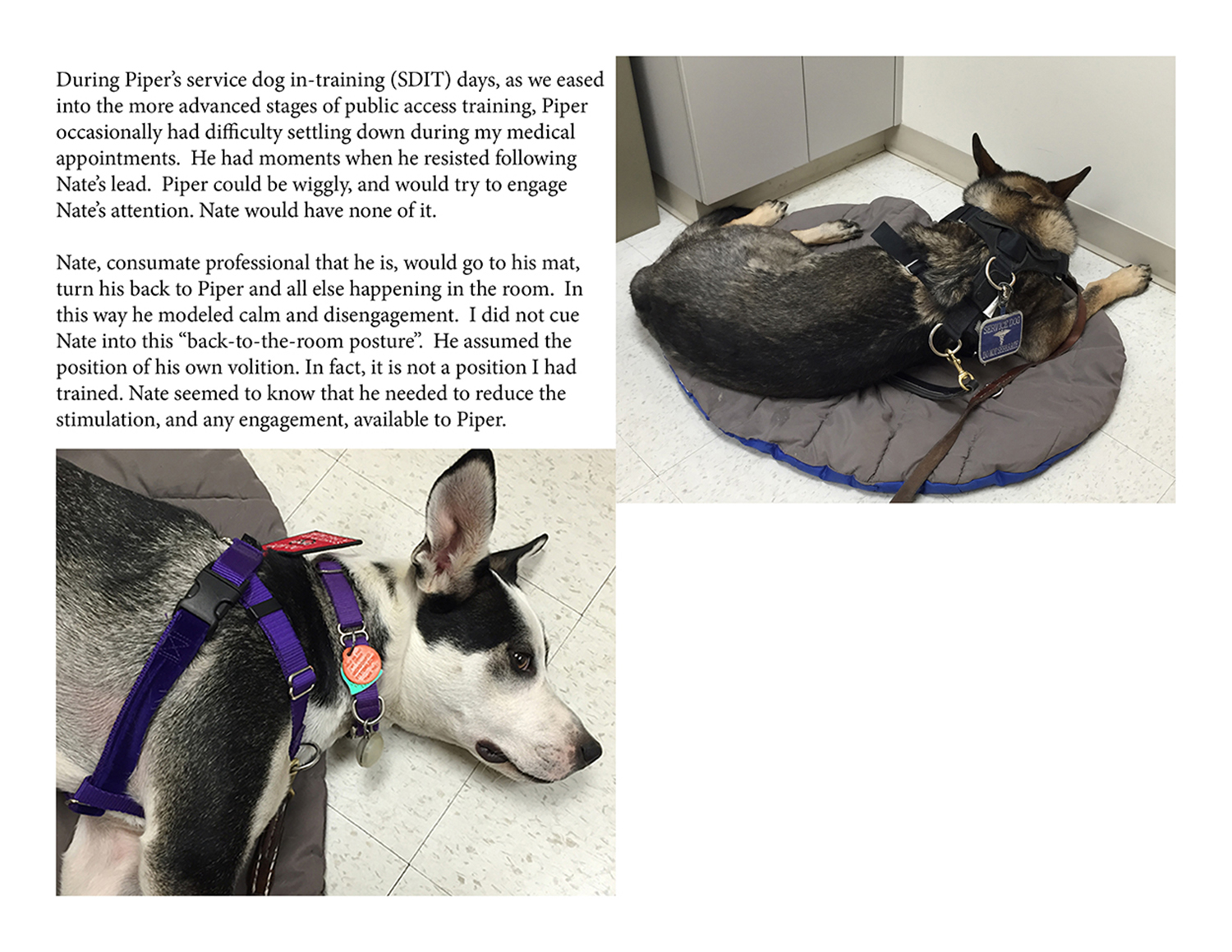
Adolescent Service Dogs in Training (SDIT) can also benefit greatly from a mentor.  In particular, they can learn to stretch their developing tolerance for a long down stay.  Often the restless teenager will relax during a long medical appointment, because that is what their role-model is doing.  An obstreperous or impatient youngster who tries to temptingly invite his mentor to play, will benefit from the mentor’s rejection of the play overtures and his modeling of appropriately quiet, relaxed behavior.

As described, pups and adolescent service dog can benefit greatly from having a canine mentor.  Mentors also benefit from their participation in the successor’s training.  Most retirees feel stressed if they are suddenly left at home while the youngster goes out for most if not all the public access outings. Sudden changes in the older dog’s routine may transform the youngster from friend to intruder in the seasoned dog’s mind.  The retiree may actually develop new or exacerbated separation anxiety, or depression upon being left alone for long hours after a lifetime of going everywhere with their handler.

Being a mentor necessarily spans many months, sometimes a year or more. Frequency of work-in-tandem gradually decreases. Over time the retiree goes on fewer outings, while he also has time to adapt to being left home alone more often. 

Nate, my German Shepherd (GSD) service dog, came to me at the age of nineteen-months.  Nate had just been released from training by the Fidelco Guide Dog Foundation, at the same moment in time when my service dog Pan, a smooth coated collie, died suddenly at the age of four-years.  Pan’s death happened without warning.  He had a catastrophic spinal stroke, and collapsed in the woods.  He was paralyzed from his mid-back down.  I opted for humane euthanization, to free him from a long, painful, and uncertain course of surgery and rehabilitation.  Nate’s failure as a guide dog candidate, and his need for an immediate career change proved a synchronistic boon.

Nate and I had a fabulous eight-year partnership. The average working-life of a GSD service dog is about nine-years. His transition from full-time service dog work to retirement began gradually. I actually started looking for his successor, years before.  I located his litter when Nate was just turning seven-years-old. I assumed basic training of his successor would take two full years. Time enough to raise Gusto from puppy to proficient adult working dog.

Nate’s temperament was so ideal, I joked that I would happily clone him in order to find his successor.  I came as close as I possibly could in Gusto. Nate’s mother, and Gusto’s mother were full sisters from different litters. 

Gusto was with us until he was eight-months-old. Sadly, when he hit adolescence he transformed from a low-drive, thoughtful pup into an extremely high-drive and powerful dog.  He became too much for me, at my current level of disability, to handle.  His departure was heart-wrenching for me and for Nate.  It was more than a month after Gusto left before Piper, then approximately eight-months-old, entered our home.  Piper, we speculate, is a border collie, Australian cattle dog, husky mix.  He is athletic and brilliant, a medium-size dog half Nate’s height and weight.

Gusto followed Nate’s lead in everything they did together.  When Piper arrived, he was a full-blown adolescent who had just been neutered.  He’d spent part of his life as a stray, likely having had to scavenge for food in order to survive.  Consequently, Piper entered our home with resource guarding issues. His first day in the house he challenged Nate for their mutually favorite resource, me!  Fortunately, Nate is the ultimate gentleman, he has no interest in fighting.  He will stand his ground if he must, but will only use superbly inhibited bites accompanied by a lot of noise and bluster.  Piper, on the other hand, had developed only poor bite inhibition in his early life, and would unreservedly continue to challenge Nate, until I hastily intervened with the blast of an air horn.  Were it not for Nate’s innate pacifistic personality, and his forgiveness toward his protégé, their co-existence might have quickly become untenable. 

Retiring a loyal working dog is inevitably emotionally difficult for the handler and the dog. Sometimes there is time to plan for it, and facilitate gradual adjustment for the retiree.  Sometimes due to illness, structural problems, or injury, retirement may be sudden.  The best of all possibilities happens when the older dog naturally assumes the role of mentor.  Mentoring profoundly benefits both dogs, it provides modeling of appropriate behavior for the successor dog, that no human trainer can replicate.  The handler, working the retiree and protégé in tandem, embarks on a highly beneficial adventure.


References

Can Dogs Learn by Observation?

https://www.clickertraining.com/node/231


Help ‘Em Up Blog

What Your Older Dog Can Teach a Puppy

February 15, 2018 Dog Health

https://helpemup.com/what-your-older-dog-can-teach-a-puppy/


Dogs Learn by Modeling the Behavior of Other Dogs

https://www.psychologytoday.com/us/blog/canine-corner/201301/dogs-learn-modeling-the-behavior-other-dogs


Social learning from conspecifics and humans in dog puppies

https://www.nature.com/articles/s41598-018-27654-0

Filed Under: Blog |

An Unexpected Study in Dog Reactivity-Part 2

April 1, 2020 By Cheryl Aguiar |

Mocha

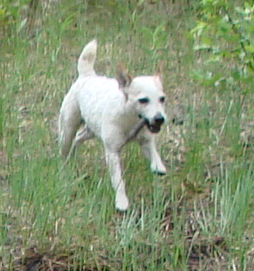
Mocha-the brown dog in this picture. I believe her racing the fence contributed to an over-excited state.

Just like Bear, Mocha lived a long time, supporting the theory that only the good die young. I believe she was 15 years old when she traveled over the rainbow bridge. The black dog in the pictures was one of her many understudies. I’m not sure why different dogs came and went at this residence, but Mocha was a constant. Mocha wasn’t always available to run down her driveway to lunge at the fence. That is because her owners had another fenced area and sometimes kept Mocha in the second area where there wasn’t any road access. I mostly saw Mocha at her gate since her property didn’t follow as much of my path to the hiking trails. I did encounter her more often in the winter when snow kept me off of the hiking trails. During the winter, I’d have to walk on the dirt roads of the subdivision.

Here you see Mocha ramping up her aggression at the fence, most likely because the fence becomes a barrier for her. 

What I found interesting about Mocha was how she was different from Bear. Mocha did get out a couple of times. However, she would never march directly towards me for an attack. Instead, she’d hang by her gate until she saw that my back was turned. Right after I turned the corner at the top of dog hill, heading back towards my house, the attack happened. Mocha would run up and nip at my back leg. If I happen to hear her coming and turned around, she’d slam on her breaks and stop her attack. A simple “go home” was enough to send her back towards her gate. Although Mocha would also go after my horse when I rode by, she never went after any of my dogs when she had that opportunity.

Letting dogs run fences can cause different kinds of reactivity and aggression issues. It is just plain a bad idea. I will confess that I never could convince any of my offending neighbors to change their behaviors.

I actually adopted a dog who the previous owner allowed to run the fence next to the road in a rural area. I’m not sure how much foot traffic Abby saw along that fence, but she sure did see auto traffic go by. I expected that Abby got very intense when racing that fence, because the first time I took her for a walk on my dirt roads, she’d thrash at the end of the leash when a car passed us by. 

The re-training of Abby supports my belief that dog trainers need to have a diversity of different techniques when working with leash reactivity. I know a lot of dog trainers have found success with dog reactivity by using BAT or LAT. Neither of those approaches would work for Abby because Abby picked up on audio cues from the car, not visual ones. I discovered that one day when walking her. The wind was gusting very hard in nearby trees, making a noise similar to a car approaching. Abby became so hyper alert she was almost over threshold as she searched for what sounded to her like a car approaching. I did get Abby’s problem completely solved, and was able to have her off leash when she went for walks with me or followed me when I rode the horse. The solution to her leash reactivity is one of the case studies in Lesson in Fear and Aggression IV, Training the Reactive and Aggressive Dog.

This is a picture of some of the training I did with Abby.

The Red and White House, and the Redirect Technique

This place was built about 20 years ago and the same people still own the place. They’ve always had aggressive dogs, and they don’t care if the dog goes through their open gate and bites you or attacks your dog. I have failed miserably in my attempts to train the people in my neighborhood, or stop people who don’t care about their dog’s aggression, though I did try.

When the people in the Red and White House first moved in and got their first aggressive dog, I was often walking on dog hill with a Jack Russell Terrier named Lestat. I had him on a leash. The first time I encountered one of their problem dogs at the red and white house was with Lestat. The problem dog saw my terrier, and ran to, then lunged at the fence. This really scared Lestat.

Here is Lestat playing with a stick.

Prior to my incident with Lestat at the top of dog hill, I had recently read about some of Dr. Dunbar’s training. I loved Dunbar’s more positive approach, which was less common in those days. One of the techniques Dunbar wrote about was called the redirect technique. I now found myself in a situation to try that technique. The very next time I took Lestat out on a walk I was ready with an armful of high value treat. The dog at the red and white house was ready as well. I lost this round, as I did the next round of trying to get Lestat to calm when going by the stretch of fence where this dog was working the fence. So I gave up on the redirect technique. 

Years later, I met a dog trainer named Nannette Nordenholt. I learned how Nannette had used the redirect technique to reform a Rottweiler who was almost euthanized due to extreme leash reactivity. The Rottweiler was so extremely leash reactive, the dog was described as going from zero-to-sixty when another dog approached. I not only learned from Nannette how and why she succeeded where I failed, but some of the knowledge I gained from her help sharpen a lot of my other training. For that reason, you will find her step-by-step training process that she used on her Rottweiler as one of the case studies in Lesson in Fear and Aggression IV, Training the Reactive and Aggressive Dog

One of the most challenging parts of dog hill was that sometimes no dogs were present when I went by, and other times some or all of the dogs were there working the fence. In later years, after Duchess was gone, Bear was almost always outside and a source of harassment. This certainly did pose challenges with training dogs, and taught me I had to find ways to work through situations with several sources of fear stimulus. 

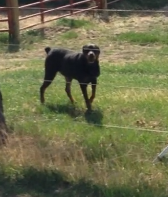
Although I didn’t get many pictures of the problematic dog pictures for the Red and White house (just didn’t have a camera along back then), I did take some pictures of one of their more recent problem dog. Below are a couple of snap shots from my camera phone while I rode by on my horse. Abby is following along behind my horse, ignoring the Rottweiler even though the dog tried to attack her one time. The time the Rottweiler got out through an unclosed gate, I had to intervene by blocking the Rottweiler with my horse. 

The Rottweiler is watching and planning his attack. I noticed that sometimes Mocha did this as well. Bear didn’t think about his attack, but would always rush towards me the moment he saw me. 

Here you see the Rottweiler’s intensity ramp up as he works the fence line. 

I hope you have enjoyed this series of blogs on reactive and aggressive dogs. I’d like to share a philosophy I’ve adopted from working with dogs over the years. 

For me, the keys to successful dog training include: Learning, trying things on a large variety of dogs, honing your skills, learning how to tweak techniques for different dogs, and then, learning more new ways to train from others who have had success. Another key to success is: don’t quit after a failure, but be on the lookout for another solution.

 
www.peggyswager.com
Member ABS and APDA member-Behaviorist

Presenter at 2016 APDT Conference
Topic-Identifying and Solving Conditioned Fear Responses
 
Newest Online Course: Fear and Aggression-The Art of Desensitization
 through e-trainingfordogs.com
Other online course:
Solving Separation Anxiety –and– Solving House Training Issues
 
!!!!CURRENT DWAA NOMINATION !!!!!
Released Feb 2015 – Rescue Your Dog from Fear-Two DWAA Nominations

Filed Under: Blog |

Jan Crary, CPDT-KA – February, 2020 Featured Instructor

February 18, 2020 By Cheryl Aguiar |

If asked what I would consider the best achievement in the 14 years of using positive relationship and clicker training the answer would be the relationship of trust love and respect build between the dog and their human.  The most heart warming compliment I ever received from my mentor Susan Sharpe was “Ava trusts you”.  Ava was a German shepherd, who I call my teacher.  She was the dog who introduced me to the power of a hot dog.  A hot dog which replaced fear with love as she overcame her fear of children.   When she looked at a child and heard the click she received a hot dog or piece of chicken or other yummy treat.  The association of a child causing fear was changed to a child making treats fall from the sky which decreased her fear.  We continued on with our relationship building and she was honored to become a Certified Therapy Dog as well as Canine Good Citizen. 
Taking all that she taught me I went on to develop my skills and knowledge and am now a Certified Professional Dog Trainer-Knowledge Assessed as well as a Dog Gone Safe Educator. Certified Fear Free Trainer and instructor through E-Training for Dogs.  Being a CPDT-KA allows me the opportunity to continue my learning through seminars and webinars to earn CEU’s to retain the certification.  I am very fortunate to live close to Wolf Park in Indiana and have attended weekend seminars with Nicole Wilde and Dr. Susan Friedman.  Along with my brain expanding with learning the having the ability interact with the domesticated wolves who have been taught using a clicker and reinforcement with a yummy treat put the escalation point behind how positive reinforcement training does work!   Also very happy to volunteer at Animal Care and Control as well Fort Wayne Pit Bull Coalition.  

Not only has this training helped me with dogs it has also helped me with the relationships with people.  It has taught me patience knowing that all are at different stages of learning.  That learning history does impact behavior.  Have clear and concise communication.  To click and treat the humans when they do a behavior to be repeated.   Have mentored others who have continued on and become CPTD-KA trainers.  These are my goals; continue learning, continue helping, and continue to be a teacher and a trainer.  Want to join me?  Enroll in one of the classes taught here. 

Student Testimonials:
“I am so impressed by Jan and her ability to train both the dogs AND the people who seek her expert advice. My dog just graduated from her basic training class, and she is not only better behaved, but the class helped us form a true bond. Now, together, we are a better pair! We understand each other better–my dog WANTS to please me and is constantly watching me to see what I want her to do next. It’s a pretty awesome feeling.”   Allison

“Jan is amazing and knows her stuff! Because of what I’ve learned from her my Bella and I have a great bond. I highly recommend Jan for any issues you may have with your four legged friends. Thank you so much for everything Jan. I can’t tell you enough how grateful I am for you sharing your knowledge with me. Oh and your patience for when I mess up more than Bella.”  Sarah

“Janis was amazing to deal with. She was kind, patient, and gave us so many tools to work with. Working with her I never felt like we were just a job to her, she truly loves what she does and she cares for the dogs she works with.”  Cassandra

Filed Under: Blog |

  • « Previous Page
  • 1
  • 2
  • 3
  • 4
  • 5
  • …
  • 16
  • Next Page »

Search this site:

SIgn up for our Newsletter

Sign up for our newsletter: Sign up for our newsletter

Follow Us

  • Facebook
  • LinkedIn
  • RSS
  • Twitter
  • YouTube

Link to Discounted Courses for Professionals

Link to Discounted Courses for Professionals

Link to Classroom For Current Students

Link to classroom: Student Classroom Link This link will work for current and registered students ONLY.

Lecture Series

Seeing Through a Dog's Nose-Canine Nose Lecture Series ALSO, Please check out our ethology and canine behavior lecture series, over 100 lectures Ethology and Canine Behavior Lecture Library Also available is our lecture series: Service Dog Training Lecture Series

What is E-Training for Dogs and how does it work?

What’s NEW?

Backing and Pivoting

Five Unique and Awesome Tricks!

Out of Control Dogs

CBCC-KA Exam Study Courses Packages

CCPDT CPDT-KSA Courses for Continuing Education

Pay Later Now Available

What’s NEW?

Backing and Pivoting

Five Unique and Awesome Tricks!

Out of Control Dogs

CBCC-KA Exam Study Courses Packages

CCPDT CPDT-KSA Courses for Continuing Education

Copyright © 2025 e-Training for Dogs | Privacy Policy