e-Training for Dogs

Online Dog Training Class | Puppy Dog Training Online | Search and Rescue Dog Training

  • Home
  • About
    • History of e-Training
    • Faculty
    • Guest Lecturers
    • Students
  • Online Learning
    • For the Dog Professional
      • Canine Professional Programs
      • Individual Courses for Professionals A-Z
      • Individual Courses for Professionals-By Interest
      • Lecture Series
        • Ethology and Canine Behavior Lecture Series
        • Service Dog Training Lecture Series
      • CCPDT CEU Approved Courses
      • IAABC CEU Approved Courses
      • NADOI Accredited Courses for CEUs
    • For the Dog Enthusiast
      • Individual Courses A to Z for the Dog Enthusiast
      • Individual Courses by Interest for the Dog Enthusiast
    • Pet-Sitting Courses
    • Animal Wellness and Animal Hospice
    • Veterinary Professional Courses
    • Equine Enthusiasts Online Courses
  • FAQ
  • Blog
  • Contact
  • Links
You are here: Home / Blog

What is the # ONE Pet First Aid Product to Have With You At All Times?

December 3, 2011 By Cheryl Aguiar |

Honey

I always carry honey when hunting or training or judging. It is my  “go to” remedy. Not only is it a life saver in hyperthermia (heat stroke), it is scientifically proven to be effective on wounds, burns, skin ulcers, boils, and infections.

Honey is one of nature’s oldest folk remedies  used by many ancient civilizations to help heal wounds.

Scientific university research is showing the reason why honey could assist natural healing. Results of a University study showed that unprocessed honey healed wounds and external ulcers in all but one of 59 patients. Honey, keeps sterile wounds sterile until they had time to heal, while infected wounds became sterile within a week. It provides a moist healing environment yet prevents bacterial growth even when wounds are heavily infected.

How does honey do this? For one, honey’s acidity, or pH, is low, preventing the growth of many species of bacteria. It tends to absorb water from a wound, which deprives bacteria of the moisture they need to thrive. When honey is diluted (i.e., from fluids from a wound) an enzyme is activated that produces hydrogen peroxide, a potent antibacterial. Honey dressings don’t stick to wounds, making it easy to change dressings with no tearing away of newly formed tissue.

Courses offered at ETD to learn more about natural remedies:
Herbal Remedies and Aromatherapy
Hands-On Healing – Practical Applications of Healing Herbs, Essences and More

First Aid and CPR

True story: I am a judge for the North American Versatile Hunting Dog Association (NAVHDA) and travel all over North America judging hunting dogs. As a Senior judge (one of the three judges must be the “Senior”) I find myself often in charge of tests. This means I am responsible for executing the test from the test logistics to the dogs to the handlers to the spectators. A couple years ago in southern California I had an experience that I will never forget.

First of all, the temperatures were 103 degrees Fahrenheit by 11AM all 3 days of the test. In the tests, we do field work, water work, and tracking. The field work is 20-30 minutes long, so we tried to get all of that out of the way first thing in the morning. However, we did not get to the tracking portion until the end of the day. Tracking USUALLY takes no more than 2-4 minutes for dogs in the test we were doing…Utility. We do not call it tracking, as the dog is only expected to follow the scent of a person dragging a dead duck behind them about 100 yards and then leaving it there for a dog to find and return to the handler…so you can imagine, the scent of that is pretty strong, and the distance is not far for an upland bird dog to run out and back.
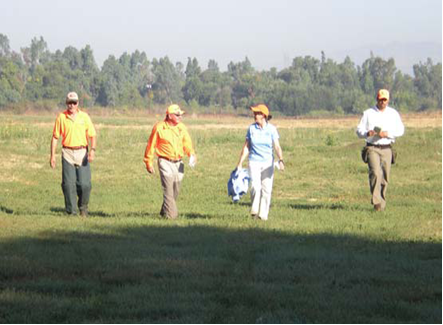
Judging Team Southern Cal NAVHDA, 2010
Greg Weiss, Herbert Schoderer, Senior Judge Cheryl Asmus
Aprentice Judge Gabriel Awbrey

Well, that day was so hot and dry and the wind…the wind was gusting about 30 mph. Each judge takes turns dragging the duck and then hiding in the woods. It was my turn. I dragged the duck out about 140 steps, left it there, and went to hide in the shaded woods (after looking for rattle snakes that might have the same idea!). The other two judges then brought out the handler and his dog who had been out of sight to the spot where the “track” started. He unleashed her, a young solid liver German Shorthaired Pointer, and she tore off down the track. Due to the wind, the track scent had blown a good 60 yards to the right so she got off the actual track air scenting landing her a good 60 yards downwind of the bird laying on the ground. She started searching, she ran and ran and ran. It was about 9 minutes into it at that point and I finally saw her run by me and pick up the duck….she was not well. I knew that instantly. I am not sure what I “saw” in the brief glimpse, but I instantly stood up and started sprinting toward the spectators, owner, and other judges. I was screaming “Get some water” “Get some water”…the wind blew my voice away.  The dog stopped about 10 yards from the owner and just stood there. By this time, someone heard me, and a spectator bolted from the crowd and yanked the duck out of the dog (which was covering its tongue…the place a dog sweats from), swooped her up and put her in a tub of cool(er) water in the shade by his truck (we had tubs of water everywhere to keep the dogs cool).

I ran to her and held her head up in that water as she was too weak to hold it herself. She was in shock but conscious. Her rectal temperature was over 105 when we first took it. We took her temperature every 5 minutes until it was normal. After her temperature dropped to under 103, we dryed her off and put her in an air conditioned car and off to the vet. She ended up being fine.

One other thing we did, was we gave her small amounts of honey on our finger and put it inside her cheek …about 2 Tablespoons in all over the 30 minutes in the water.

Honey-don’t leave home without it!

Sources:
https://manukahoney.com/resources/research/index.html
https://www.naturalfamilyawareness.com/health/index.php/2011/03/10/the-benefits-of-honey-a-remedy-for-sore-throats-wound-care-and-more-part-1/

Filed Under: Blog |

James Serpell, Ph.D.

December 1, 2011 By Cheryl Aguiar |


James Serpell is the Marie A. Moore Professor of Animal Welfare at the School of Veterinary Medicine, University of Pennsylvania, where he also directs the Center for the Interaction of Animals & Society. He received his bachelor’s degree in Zoology from University College London in 1974, and his PhD in Animal Behavior from the University of Liverpool in 1980. In 1985 he established the Companion Animal Research Group at the University of Cambridge before moving in 1993 to his current position at the University of Pennsylvania where he lectures on veterinary ethics, applied animal behavior and welfare, and human-animal interactions. His research focuses mainly on the behavior and welfare of dogs and cats, the development of human attitudes to animals, and the history and impact of human-animal relationships. In addition to publishing more than 100 articles and book chapters on these and related topics, he is the author, editor or co-editor of several books including Animals & Human Society: Changing Perspectives (1994), The Domestic Dog: Its Evolution, Behavior & Interactions with People (1995), In the Company of Animals (1996), and Companion Animals & Us (2000).

Lecture December 5, 2012 (Available recorded): Measuring Behavior and Temperament in Dogs: New Methods and Applications

Filed Under: Blog |

What can we learn about dog training from Schutzhund training and testing?

July 19, 2011 By Cheryl Aguiar |

Schutzhund is the ultimate sport if you are truly interested in not only learning the difference between play and aggression; between prey and aggression; between fear and aggression…but becoming a SCHOLAR of understanding aggression and how to know when it is and when it isn’t. I urge you to study some of the videos by Ivan Balabanov as he truly understands how to shape the natural drives of a dog with a no conflict method.

Schutzhund is a sport and a training system for a working police dog. It is a 300 point test, with three levels. 100 points are TRACKING; 100 points are OBEDIENCE; 100 points are PROTECTION. They must qualify in all three areas. A Schutzhund dog would not be very good if he tracked a lost person and then bit that person at the end of the track. A Schutzhund dog is required to heel off leash through a mingling crowd under gunfire. A Schutzhund dog is at heel, off leash, when a crowd of people walk quickly toward him and hover over him. He must show NO fear or aggression.

These dogs have exemplary temperaments. They would not get very far in Schutzhund if they did not have SELF control in any situation, no matter what is happening. Training SELF control is not achieved by force or aversion. It is achieved by shaping their natural drives. Sound familiar?

A Schutzhund dog must be able to be called to a drop in mid air after launching for a bite. They are taught to bite through the use of building their PREY drive starting with a burlap sack and tug of war with it. The reward, even after the dog has reached the highest titling possible, for that dog, is to parade around with the sleeve in his mouth, tail wagging…like he is carrying his favorite toy. When the DEFENSE drive is brought forward it is very carefully done always ending with the dog winning and ending with PREY. I believe a lot of people might learn a lot about dogs if they took a dog through the rigors of Schutzhund.

To join a sanctioned Schutzhund club and work in the three areas…my opinion…nothing better for a person or a dog…even a pet dog.

Here is a great video if you want to understand true Schutzhund training. Carefully watch the very dance these two do. I love it.

I hope you will note that the training is all motivational and when the dog is biting, at first, the helper always turns away from him building only on the PREY drive. Toward the middle-end, he briefly begins turning full frontal on the dog BRIEFLY and that turns on the defense drive, but he quickly either turns away again (prey) or lets the dog win (lets go of the burlap roll). The body language between this “helper” and this dog is incredible. Imagine people learning to read and respond as well as this “helper.” I even love the term “helper” as they are not considered trainers…they are, and think of themselves as helping shape and build a dog’s drives.

I also want to point out that Schutzhund is not JUST teaching a dog to bite. It is an organized sport as much as agility or herding. Isn’t one of the positive ways to deal with biting puppies to let them bite and then teach them how much is too much and when to quit? This is the same thing, only better.

Filed Under: Blog |

Aggressive Dogs

July 5, 2011 By Cheryl Aguiar |

I had been reading a “conversation” in one of the list serves that is subscribed to by people who are either professionals or interested in canine behavior and/or training.

The conversation was about a trainer who had tried to work with a family (husband, wife, two adolescents) with a LARGE breed dog who had bit a few times unprovoked. The trainer asked the list serve what they thought he should do.

The family had asked the trainer to take the dog to the veterinarian to be euthanized as one of their children had a disability that would make this decision not something she could understand. So the premise was the trainer was “taking” the dog, not euthanizing the dog. The details are many, but the discussion of the best solution is what I would like to talk about here. [Read more…]

Filed Under: Blog | Tagged With: agressive dogs

American Humane Hero Dog Awards

June 29, 2011 By Cheryl Aguiar |

Ok, my leap into the world of blogging.

I finally have an important push. A very special student of ours, Heddie Leger, just lost her four-legged “Hero” to cancer. Though I never met Heddie or Hero, we just have always had that connection that doesn’t seem to need real or frequent contact. It was Hero and my Rottweilers from the past that brought us together. We have had many long emails telling the stories and lessons these dogs have given us.

Hero and Heddie, among MANY things, were the demo dog for the Missouri Correctional Dog Training program called Puppies for Parole. One of Hero and Heddie’s friend, also a part of the Missouri Correctional Dog Training Program is “Captain Jack.” Captain Jack has been nominated for the “Emerging Hero Dog.” He is representing the only cancer research group. It would be such a wonderful thing for his story to win as it would be featured on the Hallmark channel. [Read more…]

Filed Under: Blog | Tagged With: American Humane Hero Dog Awards

  • « Previous Page
  • 1
  • …
  • 14
  • 15
  • 16

Search this site:

SIgn up for our Newsletter

Sign up for our newsletter: Sign up for our newsletter

Follow Us

  • Facebook
  • LinkedIn
  • RSS
  • Twitter
  • YouTube

Link to Discounted Courses for Professionals

Link to Discounted Courses for Professionals

Link to Classroom For Current Students

Link to classroom: Student Classroom Link This link will work for current and registered students ONLY.

Lecture Series

Seeing Through a Dog's Nose-Canine Nose Lecture Series ALSO, Please check out our ethology and canine behavior lecture series, over 100 lectures Ethology and Canine Behavior Lecture Library Also available is our lecture series: Service Dog Training Lecture Series

What is E-Training for Dogs and how does it work?

What’s NEW?

Backing and Pivoting

Five Unique and Awesome Tricks!

Out of Control Dogs

CBCC-KA Exam Study Courses Packages

CCPDT CPDT-KSA Courses for Continuing Education

Pay Later Now Available

What’s NEW?

Backing and Pivoting

Five Unique and Awesome Tricks!

Out of Control Dogs

CBCC-KA Exam Study Courses Packages

CCPDT CPDT-KSA Courses for Continuing Education

Copyright © 2025 e-Training for Dogs | Privacy Policy