Mocha

Mocha-the brown dog in this picture. I believe her racing the fence contributed to an over-excited state.
Just like Bear, Mocha lived a long time, supporting the theory that only the good die young. I believe she was 15 years old when she traveled over the rainbow bridge. The black dog in the pictures was one of her many understudies. I’m not sure why different dogs came and went at this residence, but Mocha was a constant. Mocha wasn’t always available to run down her driveway to lunge at the fence. That is because her owners had another fenced area and sometimes kept Mocha in the second area where there wasn’t any road access. I mostly saw Mocha at her gate since her property didn’t follow as much of my path to the hiking trails. I did encounter her more often in the winter when snow kept me off of the hiking trails. During the winter, I’d have to walk on the dirt roads of the subdivision.

Here you see Mocha ramping up her aggression at the fence, most likely because the fence becomes a barrier for her.
What I found interesting about Mocha was how she was different from Bear. Mocha did get out a couple of times. However, she would never march directly towards me for an attack. Instead, she’d hang by her gate until she saw that my back was turned. Right after I turned the corner at the top of dog hill, heading back towards my house, the attack happened. Mocha would run up and nip at my back leg. If I happen to hear her coming and turned around, she’d slam on her breaks and stop her attack. A simple “go home” was enough to send her back towards her gate. Although Mocha would also go after my horse when I rode by, she never went after any of my dogs when she had that opportunity.
Letting dogs run fences can cause different kinds of reactivity and aggression issues. It is just plain a bad idea. I will confess that I never could convince any of my offending neighbors to change their behaviors.
I actually adopted a dog who the previous owner allowed to run the fence next to the road in a rural area. I’m not sure how much foot traffic Abby saw along that fence, but she sure did see auto traffic go by. I expected that Abby got very intense when racing that fence, because the first time I took her for a walk on my dirt roads, she’d thrash at the end of the leash when a car passed us by.
The re-training of Abby supports my belief that dog trainers need to have a diversity of different techniques when working with leash reactivity. I know a lot of dog trainers have found success with dog reactivity by using BAT or LAT. Neither of those approaches would work for Abby because Abby picked up on audio cues from the car, not visual ones. I discovered that one day when walking her. The wind was gusting very hard in nearby trees, making a noise similar to a car approaching. Abby became so hyper alert she was almost over threshold as she searched for what sounded to her like a car approaching. I did get Abby’s problem completely solved, and was able to have her off leash when she went for walks with me or followed me when I rode the horse. The solution to her leash reactivity is one of the case studies in Lesson in Fear and Aggression IV, Training the Reactive and Aggressive Dog.

This is a picture of some of the training I did with Abby.
The Red and White House, and the Redirect Technique
This place was built about 20 years ago and the same people still own the place. They’ve always had aggressive dogs, and they don’t care if the dog goes through their open gate and bites you or attacks your dog. I have failed miserably in my attempts to train the people in my neighborhood, or stop people who don’t care about their dog’s aggression, though I did try.
When the people in the Red and White House first moved in and got their first aggressive dog, I was often walking on dog hill with a Jack Russell Terrier named Lestat. I had him on a leash. The first time I encountered one of their problem dogs at the red and white house was with Lestat. The problem dog saw my terrier, and ran to, then lunged at the fence. This really scared Lestat.
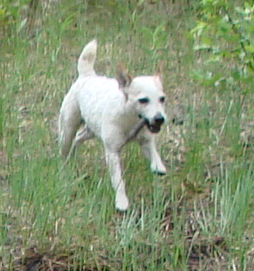
Here is Lestat playing with a stick.
Prior to my incident with Lestat at the top of dog hill, I had recently read about some of Dr. Dunbar’s training. I loved Dunbar’s more positive approach, which was less common in those days. One of the techniques Dunbar wrote about was called the redirect technique. I now found myself in a situation to try that technique. The very next time I took Lestat out on a walk I was ready with an armful of high value treat. The dog at the red and white house was ready as well. I lost this round, as I did the next round of trying to get Lestat to calm when going by the stretch of fence where this dog was working the fence. So I gave up on the redirect technique.
Years later, I met a dog trainer named Nannette Nordenholt. I learned how Nannette had used the redirect technique to reform a Rottweiler who was almost euthanized due to extreme leash reactivity. The Rottweiler was so extremely leash reactive, the dog was described as going from zero-to-sixty when another dog approached. I not only learned from Nannette how and why she succeeded where I failed, but some of the knowledge I gained from her help sharpen a lot of my other training. For that reason, you will find her step-by-step training process that she used on her Rottweiler as one of the case studies in Lesson in Fear and Aggression IV, Training the Reactive and Aggressive Dog
One of the most challenging parts of dog hill was that sometimes no dogs were present when I went by, and other times some or all of the dogs were there working the fence. In later years, after Duchess was gone, Bear was almost always outside and a source of harassment. This certainly did pose challenges with training dogs, and taught me I had to find ways to work through situations with several sources of fear stimulus.
Although I didn’t get many pictures of the problematic dog pictures for the Red and White house (just didn’t have a camera along back then), I did take some pictures of one of their more recent problem dog. Below are a couple of snap shots from my camera phone while I rode by on my horse. Abby is following along behind my horse, ignoring the Rottweiler even though the dog tried to attack her one time. The time the Rottweiler got out through an unclosed gate, I had to intervene by blocking the Rottweiler with my horse.
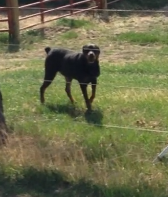
The Rottweiler is watching and planning his attack. I noticed that sometimes Mocha did this as well. Bear didn’t think about his attack, but would always rush towards me the moment he saw me.

Here you see the Rottweiler’s intensity ramp up as he works the fence line.
I hope you have enjoyed this series of blogs on reactive and aggressive dogs. I’d like to share a philosophy I’ve adopted from working with dogs over the years.
For me, the keys to successful dog training include: Learning, trying things on a large variety of dogs, honing your skills, learning how to tweak techniques for different dogs, and then, learning more new ways to train from others who have had success. Another key to success is: don’t quit after a failure, but be on the lookout for another solution.

I have been working with all breeds of dogs for over 40 years. I currently have a pet sitting business in which I try to enlighten my human clients on their four legged furry children, all while taking care of them in my clients absence. This article was extremely well written. There are so many things that spring off fence running, including fence fighting. Thank you for such a well written article. This was my first visit to this site, and it this is the caliber of information one can expect, I am a permanent fan. Thank you again.
Thank you!!!